Fire Ready
Dramatically reduce the fuel load around your home before the summer fire season.
Vegetation clearing, bushfire hazard management, and site preparation for the steep, treed blocks of the Hobart foothills.
Providing block clearing and hazard reduction in Dynnyrne and the upper slopes.
If you are preparing a block for construction or managing fire risk, you need professional Land Clearing in Dynnyrne. We handle the heavy lifting on difficult terrain.
Many larger properties in upper Dynnyrne and Ridgeway border directly onto wet sclerophyll bushland. Managing the interface between the bush and your home is critical for fire safety, but must be balanced against council habitat overlays.
Dramatically reduce the fuel load around your home before the summer fire season.
Provide a clean, safe site for your builders and earthmovers to begin work.
Turn impenetrable, weed-infested slopes into accessible, usable land.
We walk the block with you to identify trees for removal and trees for retention.
We ensure the clearing scope aligns with the Landslip Hazard Code and any DA conditions.
Our team uses chainsaws, climbers, and chippers to safely remove the vegetation.
Biomass is chipped. You can keep the mulch for soil stabilisation, or we remove it entirely.
Whether you are preparing a steep hillside block for a new architectural build, extending your property footprint, or establishing critical bushfire asset protection zones, proper site preparation starts from the ground up. At Hobart Arborist, we provide the comprehensive Land Clearing Dynnyrne property owners, developers, and builders rely on for safe, efficient, and fully compliant site transformations.
Dynnyrne’s unique geographical position against the eastern foothills of kunanyi / Mount Wellington brings specific site challenges. With shallow soils over hard dolerite rock, steep terraced terrain, and tight vehicular access, removing dense undergrowth or towering stands of white peppermint and Tasmanian blue gum requires highly specialized heavy equipment and technical expertise. A simple 'slash and burn' approach does not work on these sensitive slopes.
Our team understands the rigorous demands of clearing land in this premium Hobart suburb. We handle everything from selective clearing—designed to carefully retain significant heritage garden plantings—to full block clearing for new driveways and foundation pours. We take a systematic, arborist-led approach to vegetation removal, ensuring your site is fully prepped, stabilized, and ready for the next phase of your project without unnecessary delays.
Clearing a block is far more complex than simply pushing vegetation over with heavy machinery. In steep suburbs like Dynnyrne, aggressive and uncertified clearing operations often trigger severe soil erosion, alter natural hydrology, and catastrophically destabilize the land. When operators lack specialized arborist knowledge, they frequently compact the soil or tear recklessly through the Structural Root Zones (SRZ) of the significant trees you actually intend to keep. This inevitably leads to slow canopy decline or dangerous windthrow during Hobart's severe winter westerly wind events.
Furthermore, blind bulldozing risks serious legal consequences. Ignorance of the Tasmanian Planning Scheme and local overlays can result in hefty fines for destroying registered significant trees or breaching the Landslip Hazard Code, which strictly monitors clearing works exceeding 1,000 square metres on these vulnerable slopes.
Our solution is a meticulously managed, arborist-led clearing strategy. We comprehensively evaluate the site, identify protected significant vegetation, and deploy AS4970-compliant Tree Protection Zones (TPZ) for any trees slated for retention. By combining tracked machinery for accessible areas with technical rope-access dismantling for gullies where machines cannot safely tread, we systematically remove and process vegetation. The result is a clean, stable site that complies with Hobart City Council regulations and preserves the structural integrity of your retained landscape.
We utilize a sophisticated combination of heavy machinery, specialized access equipment, and precise arborist techniques to clear difficult Dynnyrne sites safely. Our methods are tailored to the unique terrain and specific project requirements of each property.
We carefully remove dense understory scrub, invasive weeds, and specific target trees while strictly retaining healthy stands of eucalypts or heritage European plantings. We flag retention zones and utilize precision directional felling to ensure absolutely no accidental damage to the remaining canopy.
For properties backing onto the wet sclerophyll bushland of the upper foothills, we reduce fuel loads on the bushfire interface. We selectively thin vegetation to establish fire breaks that meet AS3959 standards for bushfire-prone areas while maintaining soil stability.
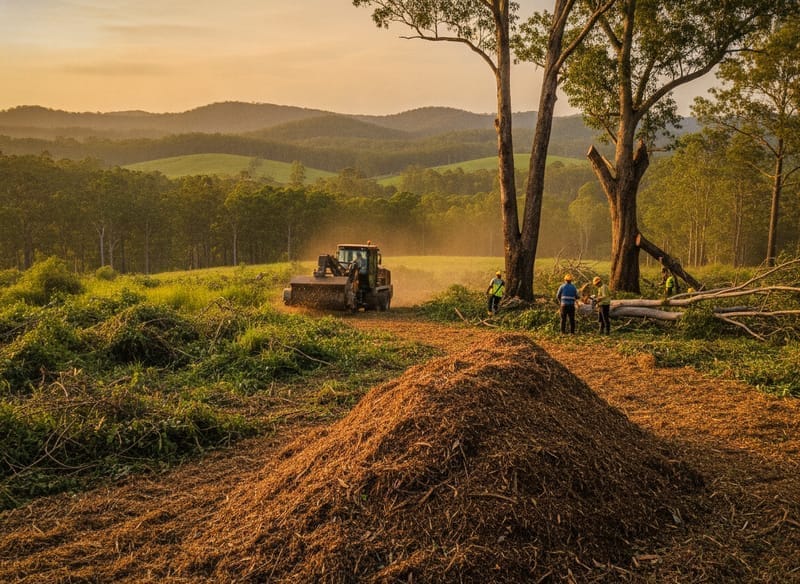
We utilize powerful tracked mini-loaders and large-capacity 12-inch wood chippers to efficiently process heavy stands of timber and dense scrub on accessible building footprints. This allows us to clear large volumes of green waste rapidly, keeping your project timeline on track.
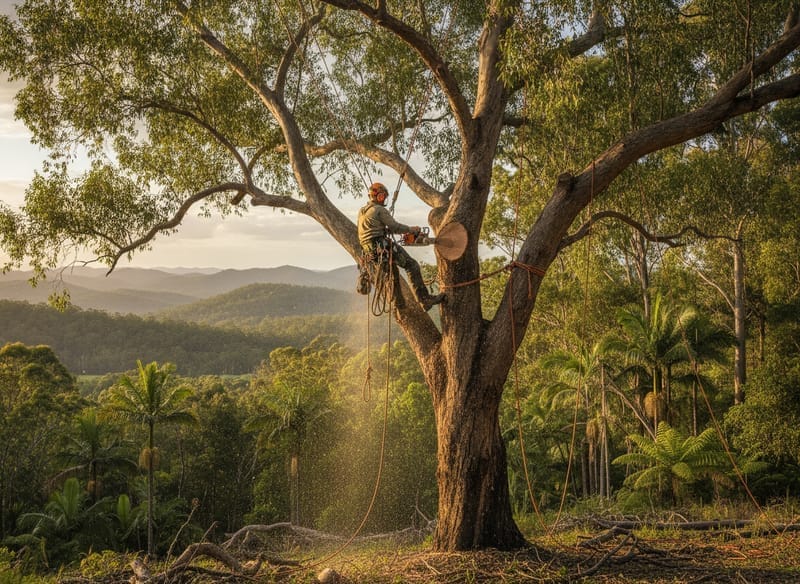
We deploy highly skilled rope-access climbing arborists to dismantle vegetation on extreme slopes or landslip-mapped areas. This technical dismantling ensures heavy machinery is kept off sensitive soils, preventing unacceptable ground disturbance and subsequent erosion.
All cleared vegetation is processed into high-quality mulch. Depending on your site requirements, this material can be uniformly spread across the block to stabilize topsoil on terraced sites, or entirely removed via our tipper trucks to leave a completely bare slate.
Every Land Clearing Dynnyrne project begins with an extensive on-site consultation. Our senior arborists will physically walk your block to fully understand your project goals, whether you are planning a modern architectural extension, a full residential build, or executing urgent fire hazard reduction before summer.
During this initial visit, we assess access constraints, measure the steepness of the terrain, and evaluate the existing vegetation profile. We also cross-reference your property against the City of Hobart’s planning scheme, checking the Local Historic Heritage Code for any registered significant trees and reviewing the latest Landslip Hazard Code mapping. If consulting arborist reports are required for council development applications, our AQF Level 5 consultants will draft the necessary documentation.
Once planning is finalized and all permits are securely in place, our crew mobilizes. We begin by clearly marking all vegetation to be retained and establishing high-visibility structural barriers. We then commence the active clearing phase, utilizing tracked loaders for accessible zones and complex rigging techniques to safely dismantle large, hazardous trees overhanging boundary lines.
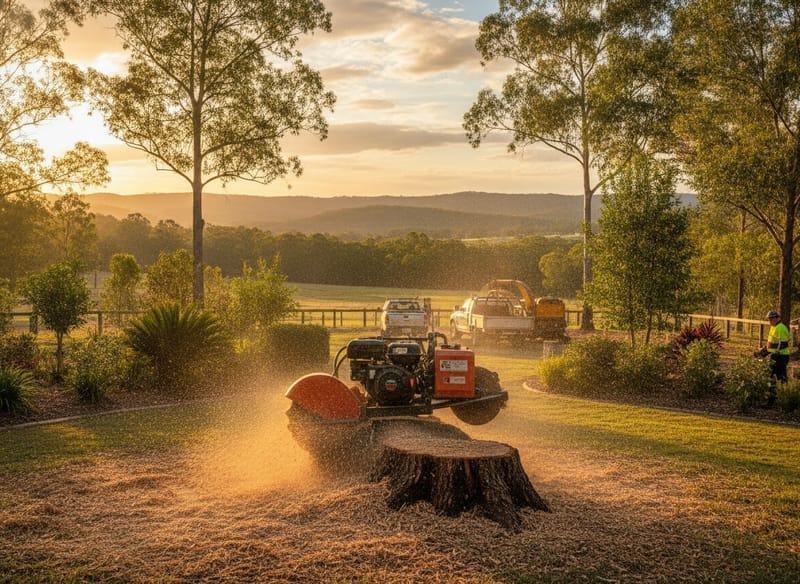
All green waste is systematically fed through our high-capacity wood chippers. Finally, we handle the remaining stumps—either grinding them below grade or employing mechanical extraction depending on your engineer's earthworks requirements. The site is raked, stabilized, and handed over completely ready for your builders.
Large-scale land clearing involves heavy machinery, falling timber, and significant operational risks. Our business operations are fully backed by comprehensive public liability insurance and WorkCover, giving you absolute peace of mind while we are on your site.
Our on-site crew includes fully qualified AQF Level 3 climbing arborists and heavy machine operators who carry all required high-risk work licenses, including professional tree felling and traffic management tickets for roadside boundary clearing. When navigating complex Hobart City Council applications, our AQF Level 5 arborists provide the necessary reporting and AS4970 Tree Protection Plans. We ensure every cut is strictly compliant with state legislation and workplace safety standards.
Executing compliant Land Clearing Dynnyrne projects requires a deep understanding of local environmental and regulatory frameworks. The suburb transitions rapidly from historic lower streets featuring massive, aging European oaks and elms, to steep upper boundaries dominated by native dry sclerophyll eucalypts like white peppermint and stringybark.
The City of Hobart does not utilize a general size trigger for tree removal. Instead, they strictly govern tree works through a Significant Tree Register and the Local Historic Heritage Code. This means clearing an established block often requires formal discretionary applications supported by an arborist report if listed trees are present.
Furthermore, the terraced nature of the kunanyi foothills means large-scale site clearing regularly triggers the Landslip Hazard Code. Removing significant vegetation on these slopes requires meticulous planning to prevent catastrophic soil failure. We factor in all these local complexities, ensuring your clearing works are legally sound and environmentally responsible.
Once our trucks and machinery leave the site, managing the newly exposed soil becomes your immediate priority. On Dynnyrne's steep and rocky slopes, we strongly recommend retaining a dense layer of our processed chipped mulch over the cleared footprint. This acts as an immediate erosion control measure against heavy rains and suppresses aggressive pioneer weeds while you finalize your construction plans.
If you have retained mature trees on the block, you must ensure your builders respect the established Tree Protection Zones and do not park heavy equipment over critical root systems. If you notice any retained trees showing signs of sudden canopy dieback or stress during the build phase, contact our arborists immediately for a health assessment.
Land clearing is priced based on the density of the vegetation and the steepness of the site.
We offer free, comprehensive site assessments and fixed-price clearing quotes.
We clear blocks and manage bushfire hazards across Dynnyrne and the mountain fringe.
Contact our local team for expert land clearing in Dynnyrne.
Get a Free Quote