Ready for Build
Hand over a clean, stump-free block to your builders on schedule.
Professional vegetation and block clearing for development and bushfire safety.
Servicing subdivisions and large blocks in Lenah Valley and Hobart's fringes.
Whether you are preparing a site for a new build or reducing fire loads, our Land Clearing in Lenah Valley provides a clean slate.
Lenah Valley sits hard against the wet sclerophyll bush of Mount Wellington. Two major codes apply here: the Landslip Hazard Code (where clearing >1000sqm requires oversight) and the Bushfire-Prone Areas Code. We specialize in interface clearing—reducing the understory fuel loads and selectively removing dangerous trees without clear-felling the entire slope, maintaining stability and council compliance.
Hand over a clean, stump-free block to your builders on schedule.
Create a defensible space around your home before the summer fire season.
Turn overgrown, unusable scrub into clear, valuable property space.
We walk the boundaries, identify trees to be retained, and check council overlays.
A detailed proposal covering felling, undergrowth clearing, and stump grinding.
We systematically drop trees and clear dense scrub using manual and mechanical methods.
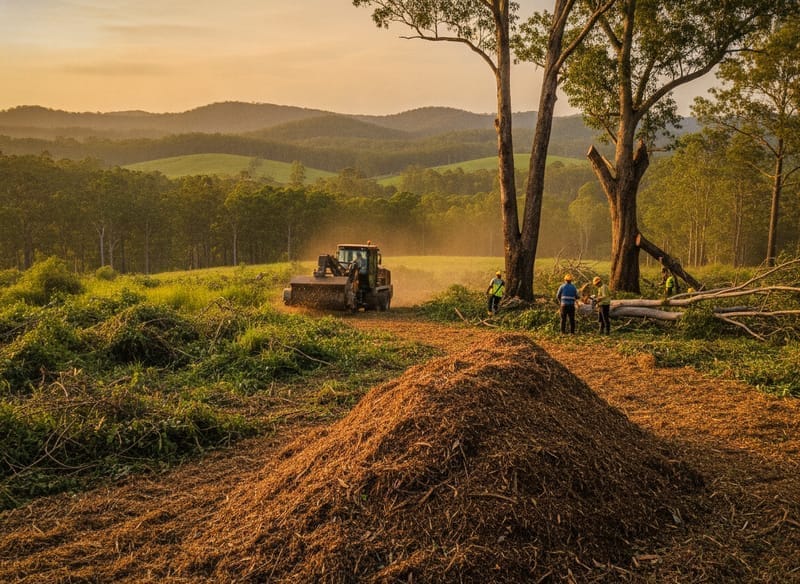
Material is heavily chipped, and larger logs are removed or stockpiled as requested.
The site is left clean and ready for your next phase of development.
When preparing a residential block for construction or mitigating bushfire risks on the foothills of kunanyi, professional Land Clearing Lenah Valley is the critical first step. At Hobart Arborist, our local crew understands the unique terrain of Hobart's western shore. Whether you are a homeowner reclaiming an overgrown gully, a developer clearing a footprint on steep dolerite slopes, or an acreage owner establishing an Asset Protection Zone (APZ), we provide the heavy machinery, climbing expertise, and local knowledge to get the site ready.
Clearing land here isn't as simple as pushing a bulldozer through the scrub. Our cool temperate maritime climate and steep topography mean that haphazard clearing can quickly lead to severe soil erosion or the destabilisation of retained trees. We take a highly calculated approach to site preparation, ensuring we selectively fell unwanted vegetation while strictly preserving the valuable eucalypts and heritage European garden species that define the character of our local suburbs.
From handling complex crane-assisted dismantles over tight boundaries to efficiently chipping massive volumes of dry sclerophyll scrub, our team delivers a turnkey service. We bridge the gap between heavy-duty land clearing and precision arboriculture, ensuring your site is safe, compliant, and ready for its next phase.
Attempting large-scale vegetation removal without a qualified arborist is a fast track to costly site complications. We regularly see the aftermath of poorly executed clearing jobs in the greater Hobart area: heavy machinery tearing up critical root zones of trees slated for retention, careless felling that damages adjacent property, and bare, un-mulched slopes left totally exposed to winter westerly fronts and heavy runoff.
More critically, under-qualified operators or broad-scale earthmovers often fail to navigate local compliance, inadvertently breaching the City of Hobart's codes. Clearing the wrong vegetation on a steep block can trigger landslip hazards, while damaging a mature tree listed on the Significant Tree Register can result in severe council penalties and project delays. Furthermore, simply pushing trees over leaves massive root balls in the ground, complicating your earthworks and increasing bulk haulage costs.
Our team at Hobart Arborist provides a precise, compliance-driven solution. Led by AQF-qualified arborists, we assess the site before a single chainsaw is started. If your project requires the retention of specific trees for planning approval, we establish rigid Tree Protection Zones (TPZ) in accordance with AS4970 Protection of Trees on Development Sites. We manage the directional felling, dismantling, and processing of all designated scrub and timber, leaving you with a clean, stable, and construction-ready block.
We offer comprehensive vegetation management tailored to the steep blocks, narrow access roads, and diverse flora of the Hobart foothills. Our equipment and methods are selected to maximise efficiency without compromising the structural integrity of your soil or retained trees.
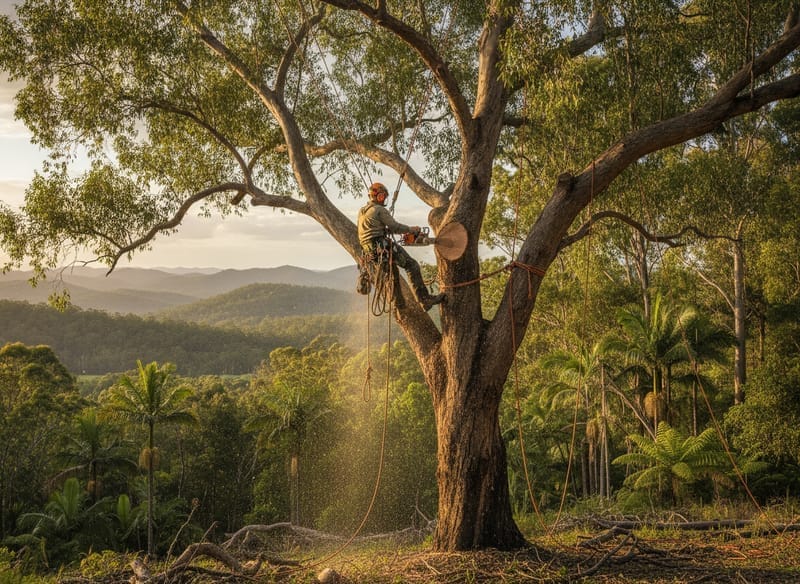
We safely clear all scrub, understory, and designated trees from your planned building envelope. For blocks with tight access or zero rear vehicle entry, our climbers use advanced single and double-rope access techniques to dismantle canopy trees piece by piece, ensuring zero impact on your retained vegetation or neighbouring property.
We help you meet your BAL rating requirements under AS3959. This involves selectively thinning canopy density, removing volatile undergrowth, and creating essential vertical and horizontal separation between the dry sclerophyll bushland interface and your home, a critical service for properties backing onto Mount Wellington.
When the Tasmanian Planning Scheme mandates the preservation of specific canopy trees during your subdivision or build, we establish Structural Root Zones (SRZ) and protective fencing to ensure heavy construction machinery does not cause fatal root compaction or soil grade changes.
For larger properties heading up the mountain flank, we clear dense scrub and fallen timber to establish clear boundary lines for new fencing or safe vehicular access tracks. We utilise ground saws like the MS500i and 572XP to safely fell and cross-cut timber, processing the material on-site.
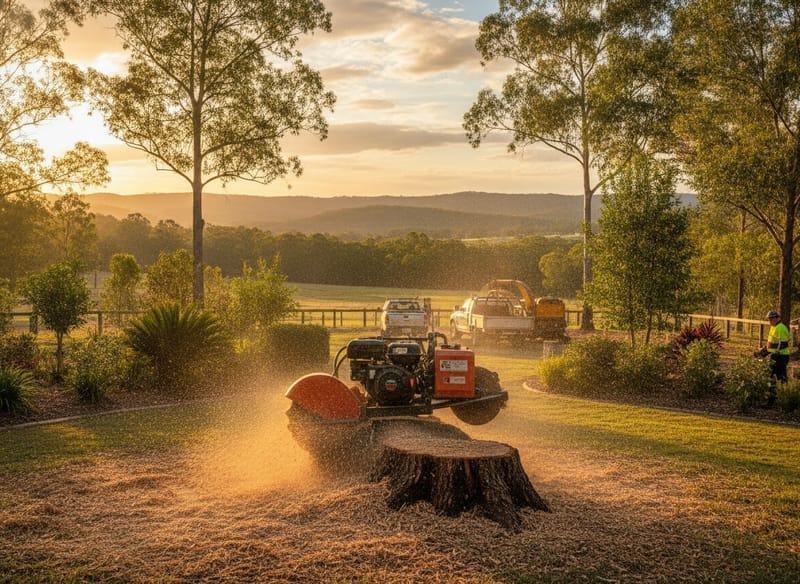
Our commercial-grade 12-inch wood chippers turn cleared scrub into high-quality mulch. We can retain this on your site to immediately stabilise bare dolerite soils against erosion, or completely remove it in our tipper trucks. Designated stumps are ground 150-300mm below grade to allow for immediate earthworks and landscaping.
Every block is unique, and our process is designed to handle everything from standard residential site prep to complex, sloping land over dolerite bedrock.
Step one is a comprehensive site assessment. Our quoting arborist will visit your property to evaluate the terrain, the volume of vegetation, and site access. We check for steep slopes that might fall under the Landslip Hazard Code and identify any significant species that require careful navigation or specific council exemptions. If your street requires it, we plan for formal traffic management (RIIWHS205D).
Step two involves detailed planning and council checks. We review the proposed scope against the Tasmanian Planning Scheme - Hobart, confirming if an AQF Level 5 consulting arborist report is required for your development application, or if the work falls under standard fire hazard reduction or building maintenance exemptions.
Step three is the physical execution. Our AQF Level 3 climbers and ground crew arrive with heavy ground saws, top-handle climbing saws, and large-capacity chippers. Trees are directionally felled or dismantled via complex rigging if the site is tight. We process the canopy into mulch and segment the heavy timber for removal.
Step four is final site handover. We grind the remaining stumps, spread or remove the mulch as requested, and ensure the site is safe, tidy, and ready for your builders or landscapers to take over.
Land clearing involves high-risk felling and the use of heavy machinery, making strict compliance non-negotiable. Our operations are governed by AS4373 (Pruning of Amenity Trees) for any retained tree works, and AS4970 for protecting trees during development.
Our team consists of fully qualified AQF Level 3 arborists for all practical tree work, and we have AQF Level 5 consulting arborists available for complex DA reporting. We are fully public liability insured and carry comprehensive WorkCover for all our employees. From managing roadside traffic on narrow foothill streets to implementing Safe Work Method Statements (SWMS) for steep terrain, we protect your property and our crew at every stage.
Delivering effective Land Clearing Lenah Valley requires a deep understanding of our local environment. Situated on the eastern foothills of kunanyi / Mount Wellington, properties here feature shallow soils, steep gradients, and dense stands of dry sclerophyll eucalypts like white peppermint, Tasmanian blue gum, and stringybark, often mixed with heritage European plantings.
Under the Tasmanian Planning Scheme - Hobart, vegetation removal must be carefully considered. While there is no blanket size trigger for tree removal, the Local Historic Heritage Code heavily protects trees listed on the Significant Tree Register. Furthermore, the Landslip Hazard Code is highly relevant; clearing more than 1,000 square metres on our steep slopes is classified as significant works and requires careful management.
Because rear vehicle access is often non-existent in these terraced foothill blocks, our team relies heavily on advanced rope access, spider lifts, and crane-assisted removals. This allows us to clear heavily vegetated gullies safely without relying on bulky earthmoving equipment that cannot negotiate the terrain.
Once your block is cleared, managing the exposed soil is your first priority. We highly recommend spreading the freshly chipped mulch across the site to retain soil moisture, suppress opportunistic weed growth, and prevent topsoil runoff during Hobart's winter rains.
If we have established Tree Protection Zones for retained eucalypts or heritage trees, it is crucial that these remain undisturbed throughout your subsequent building phase. Keep heavy trades, spoil, and material storage well outside the fenced root zones. If you notice signs of stress, such as epicormic shoots or sudden canopy dieback on retained trees following major wind events, contact our arborists immediately for a health assessment.
Land clearing is quoted based on the density of vegetation and the size of the block.
We provide detailed, transparent quotes for large-scale clearing projects.
Clearing services for interface properties and subdivisions.
Contact us for professional, compliant land clearing in Lenah Valley.
Get a Clearing Quote