Preserved Tree Health
Your trees retain their natural defence mechanisms against pests and disease.
Looking for tree lopping? We provide safe, standard-compliant height reduction and pruning that protects your trees and property.
Providing expert canopy care in Mount Nelson, Ridgeway, and Sandy Bay.
If your trees have outgrown their space, our Tree Lopping Mount Nelson alternatives provide the perfect solution.
Many Mount Nelson residents want to lop trees to restore views of the Derwent River. We offer targeted canopy thinning that achieves this without destroying the tree's health.
Your trees retain their natural defence mechanisms against pests and disease.
Proper pruning techniques ensure that any new growth is structurally sound.
Maintain the beautiful, natural silhouette of the tree instead of leaving ugly stubs.
We discuss what you want to achieve (e.g., view restoration, clearance) on your Mount Nelson property.
We explain how we can meet your goals using AS4373-compliant reduction instead of lopping.
Our climbers carefully reduce the canopy, making cuts at appropriate growth nodes.
All green waste is mulched and removed.
When it comes to managing the mature canopy of the Hobart foothills, professional Tree Lopping Mount Nelson property owners can rely on is essential for balancing safety, light, and property preservation. Nestled on the steep eastern flanks of kunanyi / Mount Wellington, blocks here are heavily wooded, often terraced, and exposed to unpredictable westerly wind events. If your white peppermint (*Eucalyptus pulchella*) or mature elm is casting too much shade, dropping debris on the roof, or encroaching on powerlines, it is time for a professional assessment.
While "lopping" is the common term locals use when they want a tree made smaller or pulled back from their home, the actual process requires precision. Hacking a tree back indiscriminately only leads to weak regrowth and accelerated decay.
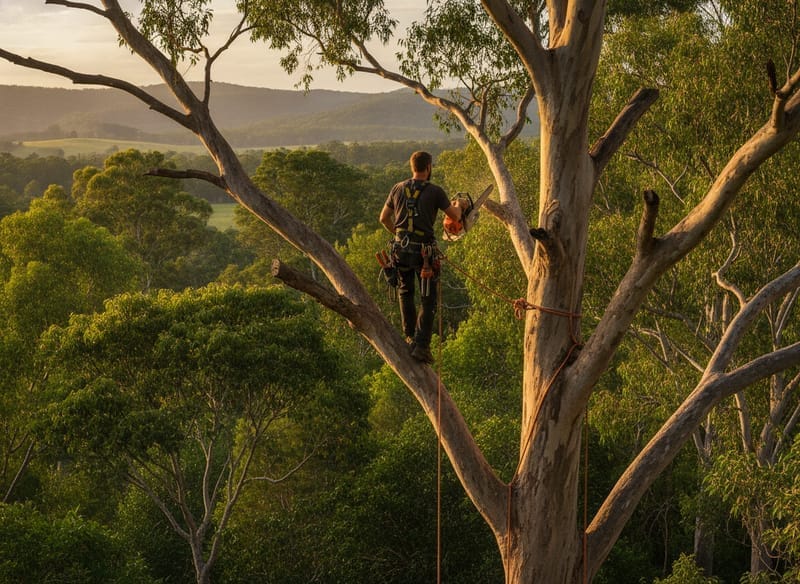
Our team of qualified arborists understands the distinct challenges of Mount Nelson, Ridgeway, Tolmans Hill, and South Hobart. We use advanced rope access and precise pruning techniques to reduce canopy spread, lift low-hanging limbs, and manage bushfire hazards without ruining the structural integrity of your trees.
Many homeowners think tree lopping simply involves cutting the top off a tree to restrict its height. In reality, aggressive "topping" or heading back leaves large, jagged stubs. This practice severely stresses the tree, forcing it to push out rapid, poorly attached epicormic growth. In our wind-prone foothills, these weak new branches are the first to snap and fall on roofs during a winter gale.
Attempting to lop heavy limbs yourself on the steep, dolerite-soiled slopes of Mount Nelson is also incredibly dangerous. Without proper rigging equipment and working-at-heights training, managing the swing and drop of tonnes of timber over tiered gardens and narrow streets is a recipe for property damage.
We provide a professional solution. When looking for the safest Tree Lopping Mount Nelson has to offer, we deliver targeted, AS4373-compliant pruning. Instead of indiscriminate hacking, we evaluate whether your Tasmanian blue gum or introduced oak needs crown reduction, thinning, or complete removal. The result is a safer, more manageable tree that adds value to your property rather than becoming a high-risk liability.
When you ask for tree lopping, our climbers apply the specific pruning method that best achieves your goal while protecting the health of the tree.
The correct arboricultural approach to making a tree smaller. We carefully prune the canopy back to suitable growth points, reducing overall height and spread while maintaining a natural shape. This is strictly limited to an acceptable percentage of the live crown (typically under 25%) to prevent tree stress.
If a tree is blocking your driveway, shading out the garden, or encroaching on your roof, we remove the lower branches. This creates clear vertical space without needing to alter the upper canopy.
We selectively remove secondary branches throughout the canopy to allow more wind and light to pass through. This significantly reduces the "sail area" of large stringybarks or elms, making them far less prone to failure during severe westerly winds.
Precision cuts targeted at specific problem limbs. Whether a branch is interfering with service wires or resting on a gutter, we remove the hazard using correct branch collar cuts to ensure rapid healing and prevent decay.
Following storm damage or sudden limb failure, we safely dismantle shattered or hung-up branches. If a tree poses an immediate structural risk, partial reduction may be used to stabilise the canopy prior to a complete, controlled removal.
Every site in the Hobart foothills presents unique access and terrain challenges. We have developed a streamlined process to ensure your tree reduction work is carried out smoothly, safely, and efficiently.
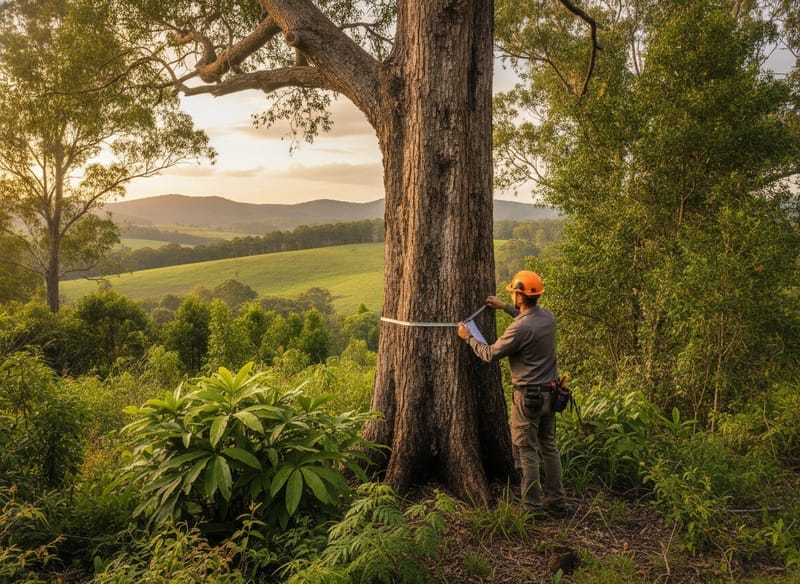
1. On-Site Assessment and Consultation We visit your property to assess the tree's species, health, and location. We discuss what you want to achieve—whether that is clearing a roofline or improving sunlight—and recommend the most effective pruning or reduction method.
2. Transparent Quoting and Planning You receive a detailed, fixed-price quote outlining the exact scope of works. If the tree falls under the City of Hobart's Local Historic Heritage Code or is on the Significant Tree Register, we can advise on the required arborist reports and application steps.
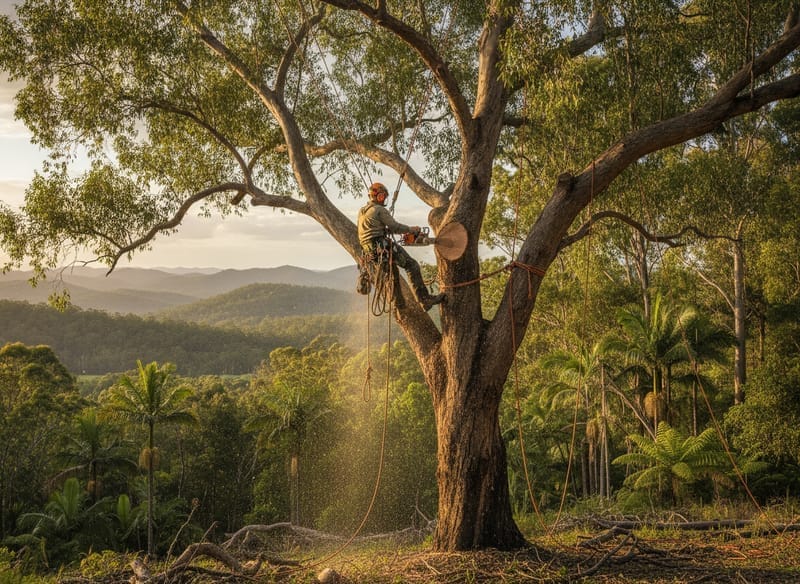
3. Safe Canopy Access and Rigging Because Mount Nelson properties often have restricted vehicle access, our AQF Level 3 climbing arborists utilise advanced single-rope and double-rope access techniques. For limbs overhanging houses, we use heavy-duty rigging gear to lower timber to the ground in controlled sections.
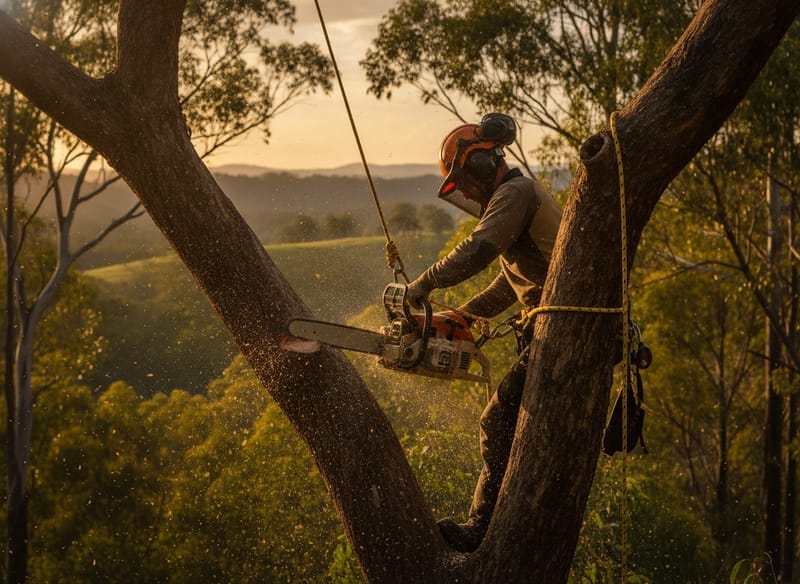
4. Precision Pruning and Processing Using top-handle climbing saws, we execute clean, compliant cuts. All branches and foliage are systematically lowered and processed through our commercial chippers positioned on the street or driveway.
5. Complete Site Cleanup We take pride in leaving your property immaculate. All timber, twigs, and debris are raked and removed, leaving your garden exactly as we found it—just with much better light and a safer canopy overhead.
All tree lopping and pruning work performed by our team strictly adheres to AS4373 (Pruning of Amenity Trees). This national standard guarantees that every cut is made to promote healing, minimise disease ingress, and maintain structural integrity.
Our business is fully public liability insured and covered by WorkCover, protecting you, your property, and our staff. Every climber holds the required AQF Level 3 qualifications, EWP tickets, and Working at Heights certifications. Should your project require a formal impact assessment for council planning, our AQF Level 5 consulting arborist can provide the necessary documentation.
Managing vegetation in Mount Nelson involves distinct local variables. Our suburb transitions rapidly from the dry sclerophyll bush of the foothills—dominated by silver peppermint and manna gum—to established residential gardens featuring massive European oaks and macrocarpa.
Because many properties sit on steep inclines with shallow soils over dolerite, trees here are highly vulnerable to the strong north-westerly fronts that batter Hobart. Thinning out the canopy to reduce wind resistance is a critical preventative measure ahead of storm season.
Additionally, while everyday garden pruning is generally exempt from permits, the City of Hobart heavily regulates works on trees listed on the Significant Tree Register or located within historic landscape precincts under the Local Historic Heritage Code. Pruning to improve health is fine, but aggressive lopping or removal requires approval. Landslip Hazard Code overlays also affect major clearing on the slopes. Tasmania has no 10/50 style clearing scheme, so we ensure all our hazard reduction work is perfectly compliant with the Tasmanian Planning Scheme.
Once your tree has been professionally pruned or reduced, it requires very little immediate intervention. The clean branch collar cuts we make will naturally occlude (heal over) without the need for sealants or paints.
During the first summer following significant canopy reduction, ensure the root zone receives adequate water, as the tree will be expending energy to compartmentalise the pruning wounds. Keep an eye out for any aggressive, straight-up epicormic shoots; while our AS4373-compliant methods minimise this, some species like Tasmanian blue gum may still push out minor reactive growth.
We recommend a follow-up assessment every three to five years. If you notice any sudden dieback, fungal brackets on the trunk, or newly hanging branches after a severe winter storm, contact us immediately for an inspection.
Pricing for canopy reduction depends on tree size and access, but is a much better investment than dealing with a ruined, lopped tree.
We offer free, honest quotes that outline the correct, compliant methods for your trees.
We provide proper tree management across the area.
Talk to our arborists in Mount Nelson about safe, compliant canopy reduction.
Get a Free Assessment