Smooth Council Approvals
Submit planning applications with the correct, expected documentation.
Comprehensive AQF Level 5 reports for council applications, heritage trees, and risk management.
Providing consulting services in Mount Stuart and across Hobart.
When you are asked for an Arborist Report Mount Stuart by the City of Hobart, it means you need a 'suitably qualified person' to assess the tree. That's us.
Mount Stuart's high concentration of heritage-listed homes and significant trees means any substantial tree work or development often triggers a request for a formal report.
Submit planning applications with the correct, expected documentation.
Justify removals or pruning with professional, documented evidence.
Ensure construction machinery doesn't inadvertently kill retained trees.
We discuss your goals—whether it's building an extension or removing a hazardous oak.
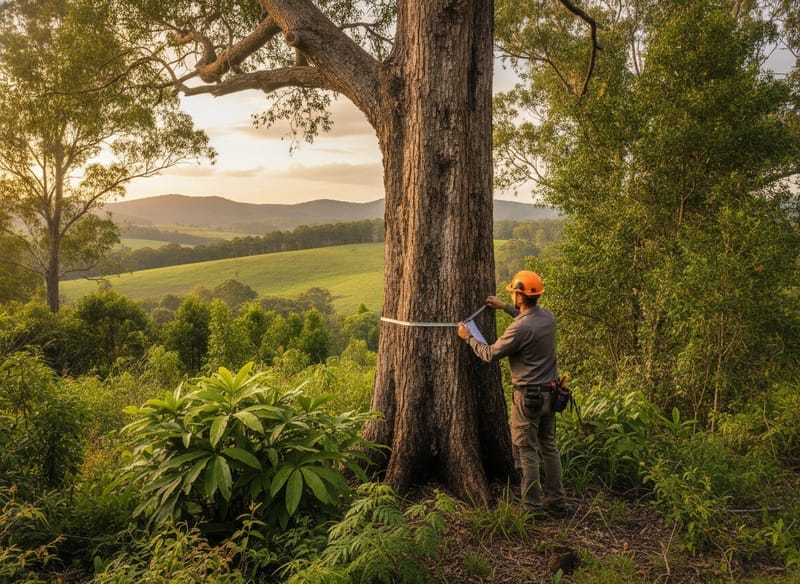
Our Level 5 Arborist visits your Mount Stuart property to gather data, measure DBH, and assess vitality.
We compile the data into a formal, structured report meeting council standards.
You receive a PDF copy ready for submission to the City of Hobart.
When planning a build, navigating a subdivision, or managing large established trees on your property, a certified Arborist Report Mount Stuart is often the crucial first step. The eastern foothills of kunanyi/Mount Wellington feature a unique blend of steep terrain, mature native eucalypts, and century-old European garden plantings. Whether you are dealing with a potentially hazardous Tasmanian blue gum overhanging your roof or require a tree protection plan for a development application (DA), having accurate, formal documentation is non-negotiable.
At Hobart Arborist, our consulting arborists provide comprehensive, objective, and legally sound reporting to property owners, builders, and developers across Mount Stuart and the wider Hobart region. We bridge the gap between your property goals and the strict requirements of the City of Hobart. By engaging our AQF Level 5 qualified arborists, you ensure your project is assessed against industry best practices, minimising costly council delays and ensuring the long-term safety of your landscape.
A common and costly mistake made by property owners and developers is relying on an unqualified tree lopper or a builder's visual guess to justify tree removal or retention. The City of Hobart operates under strict planning frameworks. Submitting a development application or a removal request with a generic letter rather than a formal, AQF Level 5 consulting arborist report almost guarantees immediate rejection or Request for Further Information (RFI) delays.
Furthermore, DIY assessments often fail to identify structural defects hidden within a mature tree's canopy or root system. In Mount Stuart, where shallow dolerite soils and strong westerly wind events are common, misdiagnosing the health of a large white peppermint or historic elm can lead to catastrophic property damage.
Our team solves these problems by providing authoritative, AS4970 and AS4373 compliant arborist reports. We conduct thorough Visual Tree Assessments (VTA) to document defects, target zones, and the likelihood of failure. When it comes to developments, we clearly define Tree Protection Zones (TPZ) and Structural Root Zones (SRZ) so your builders know exactly where they can and cannot excavate. With our reports, you secure the evidence needed to satisfy council planners, protect your liability, and keep your project on schedule.
Our consulting arborists draft highly technical, legally robust documents tailored to the specific needs of your property and local council regulations. Every assessment is grounded in verified arboricultural science.
Required by the City of Hobart when a DA proposes works near, or the removal of, protected trees. We provide a complete tree inventory, species identification, Diameter at Breast Height (DBH) measurements, and Safe Useful Life Expectancy (SULE) ratings. Our reports deliver clear retention recommendations to satisfy council planning criteria.
Essential for any construction near retained trees. We map out the exact Tree Protection Zones (TPZ) and Structural Root Zones (SRZ) in accordance with AS4970. The report details required fencing, root mapping, mulch protection protocols, and supervised work zones to ensure machinery does not compact soils or sever vital root systems during your build.
Using industry-standard Visual Tree Assessment (VTA) principles, we evaluate trees for structural integrity, decay, and disease. We document potential target zones (such as houses or driveways) and assess the likelihood and consequence of failure. This is highly recommended for pre-purchase inspections, neighbour disputes, or meeting duty-of-care obligations.
When seeking council approval to remove a tree protected under local overlays or the Significant Tree Register, a formal justification is required. We document the tree's deteriorating condition, unacceptable safety risks, or structural damage it may be causing to buildings, providing the definitive evidence needed to support a removal application.
For properties where proposed building envelopes closely approach mature trees, we oversee non-destructive root investigations (such as hydro-excavation). We report on the density, size, and health of the root system encountered, advising developers whether the foundation design will fatally impact the tree.
Securing a professional arborist report with our team is a streamlined, transparent process designed to give you clarity from day one.
First, we begin with an initial consultation. We discuss the purpose of the report—whether it is a DA requirement, a hazard concern, or a heritage-listed tree issue. We will ask for your site plans if you are building, and review the property against the Tasmanian Planning Scheme - Hobart to identify any relevant overlays immediately.
Next, our AQF Level 5 consulting arborist attends your Mount Stuart property. We conduct a rigorous on-site inspection, taking DBH measurements, canopy spread dimensions, and high-resolution photographs. We assess the immediate environment, including soil conditions, slope, and proximity to infrastructure, noting any signs of disease, decay, or structural weakness.
Back at the office, we draft the comprehensive document. We calculate TPZ and SRZ areas, cross-reference our findings with the Local Historic Heritage Code or significant tree registers, and formulate objective recommendations.
Finally, we deliver the completed, signed Arborist Report in PDF format, ready for direct submission to the City of Hobart or your certifier. If council has follow-up questions, we remain available to provide professional clarification.
In Tasmania, local councils require formal tree reports to be authored by a consulting arborist holding an AQF Level 5 Diploma of Arboriculture. Our team meets this strict requirement. We write every document in strict accordance with AS4970 (Protection of Trees on Development Sites) and base all pruning or remediation recommendations on AS4373 (Pruning of Amenity Trees).
Beyond qualifications, Hobart Arborist is fully insured, carrying comprehensive Public Liability, WorkCover for our staff, and Professional Indemnity insurance. This ensures that when we provide expert advice on the safety, retention, or removal of a massive canopy asset, you are entirely protected. We do not guess; we apply scientific SULE ratings and industry-standard risk matrices.
Writing an accurate Arborist Report Mount Stuart requires deep local knowledge of both the environment and the municipal red tape. Mount Stuart sits on the steep eastern foothills of kunanyi, featuring shallow dolerite soils and regular exposure to intense westerly winds. The canopy here is highly mixed: dry sclerophyll natives like white peppermint and Tasmanian blue gum blend into historic 1880s–1920s European garden plantings, including massive oaks, elms, planes, and cedars.
Under the Tasmanian Planning Scheme - Hobart, the Local Historic Heritage Code is the primary control for tree works in these older suburbs. A tree may be protected if it sits on the Significant Tree Register, within a heritage precinct, or on a local heritage place. In these instances, pruning beyond minor maintenance or outright removal demands a discretionary application. Furthermore, the Landslip Hazard Code heavily influences earthworks and clearing on our sloped blocks. Our consulting arborists understand exactly how to assess your trees against these specific Hobart planning instruments.
Once you receive your arborist report, the immediate next step is submission. For development projects, hand the PDF to your draftsperson or town planner to lodge with your DA. Before construction begins, you must install the AS4970 compliant protective fencing exactly as mapped in our Tree Protection Plan.
If the report recommends remedial pruning, weight reduction, or tree removal, you can seamlessly transition to our AQF Level 3 climbing arborists. Our operational crews will execute the physical tree work exactly as specified by the consulting arborist, ensuring compliance with AS4373. For ongoing risk management of retained mature trees, we recommend booking a reassessment every 18 to 24 months.
Consulting reports are priced based on the scope and number of trees.
We provide a fixed-fee proposal before any consulting work begins.
Providing expert consulting across the region.
Speak to our AQF Level 5 arborists today for expert advice in Mount Stuart.
Request a Quote