Safe Solutions
Manage tree height without creating dangerous regrowth.
Professional canopy management, height reduction, and safe alternatives to destructive lopping.
Servicing Mount Stuart, West Hobart, and Lenah Valley.
If you are searching for Tree Lopping Mount Stuart because a tree has outgrown its space, we can help you manage it correctly.
Mount Stuart's large heritage species like elms and planes respond terribly to lopping, developing rampant decay. We manage their size using arborist best practices.
Manage tree height without creating dangerous regrowth.
Protect the tree's vascular system with proper pruning cuts.
Ensure your tree work complies with local planning rules.
We evaluate why you want the tree lopped and suggest the best arborist-approved solution.
A clear, fixed-price quote for height reduction, pruning, or removal.
Our climbers perform the work using correct techniques.
Branches are chipped and removed from the site.
If you are looking for professional Tree Lopping Mount Stuart, our expert arborist team is here to help you manage the height, spread, and safety of your canopy. Properties in this beautiful part of Hobart often feature a stunning but challenging mix of established historic gardens and towering native bushland. Over time, these trees can quickly outgrow their space, encroaching on rooflines, blocking solar panels, or casting heavy shade over steep, terraced backyards.
When homeowners ask us to "lop" a tree, their goal is usually simple: make the tree smaller, safer, and more manageable. However, hacking branches indiscriminately can destroy a tree and create extreme safety hazards. As local arborists, we understand the specific challenges of the kunanyi / Mount Wellington foothills. We provide standard-compliant canopy reduction and pruning that achieves your goals—reducing wind load and increasing light—while preserving the health, structure, and aesthetic value of your trees.
In traditional terms, "tree lopping" refers to indiscriminate topping—making blunt, heading-back cuts that leave large stubs. While this might quickly reduce a tree's height, it is highly damaging. When a mature Tasmanian blue gum or a historic English oak is hard-topped, the tree responds by aggressively pushing out spindly, weakly attached epicormic shoots. Within a few years, you end up with a denser, top-heavy canopy that is highly susceptible to snapping during Mount Stuart's notorious winter westerly wind events.
Furthermore, large stubs cannot heal properly, inviting extensive decay into the main trunk and shortening the tree's safe lifespan.
Our team provides the solution by applying AS4373-compliant arboricultural methods. We don't just lop trees; we strategically reduce them. By using branch collar cuts and target pruning, we can reduce the overall height and spread of your tree, lift the canopy away from your roof, and thin out the foliage. This achieves the clearance and safety you need without destroying the tree's structural integrity or triggering a messy dispute with the City of Hobart over damaged significant trees.
When you ask us to lop a tree, we assess your specific site requirements and apply targeted, standard-compliant pruning techniques to achieve your goals safely and sustainably.
Decreases the overall height and spread of the tree. We cut back to appropriate lateral branches rather than leaving blunt stubs, preserving the tree's natural shape while significantly reducing its wind profile.
Removes the lower branches to provide clearance for pedestrians, vehicles, and sightlines. Ideal for large exotics or eucalypts overhanging driveways, powerlines, or terraced gardens.
Selectively removes secondary branches throughout the canopy. This allows more light into your home and lets strong westerly winds pass through safely, reducing the risk of uprooting on steep dolerite slopes.
Targets specific problem limbs, such as those encroaching on roofs or neighbour boundaries. We achieve necessary clearance without compromising the health or balance of the entire tree.
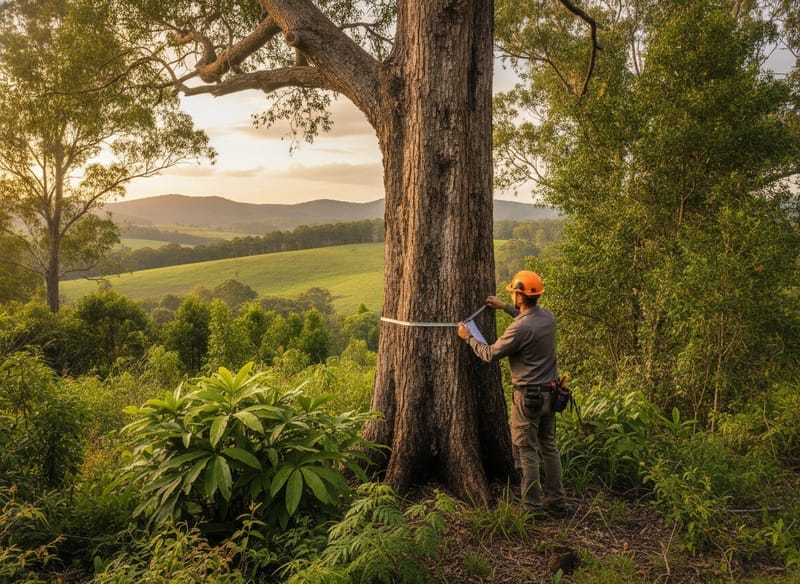
Step 1: Site Inspection and Assessment. We visit your Mount Stuart property to inspect the tree's health, species, and the surrounding terrain. We discuss your exact goals—whether that is gaining more light, reducing roof overhang, or mitigating storm hazards—and determine the right pruning approach.
Step 2: Transparent Quoting. We provide a clear, itemised quote detailing the exact canopy reduction methods we will use. There are no hidden fees or guesswork.
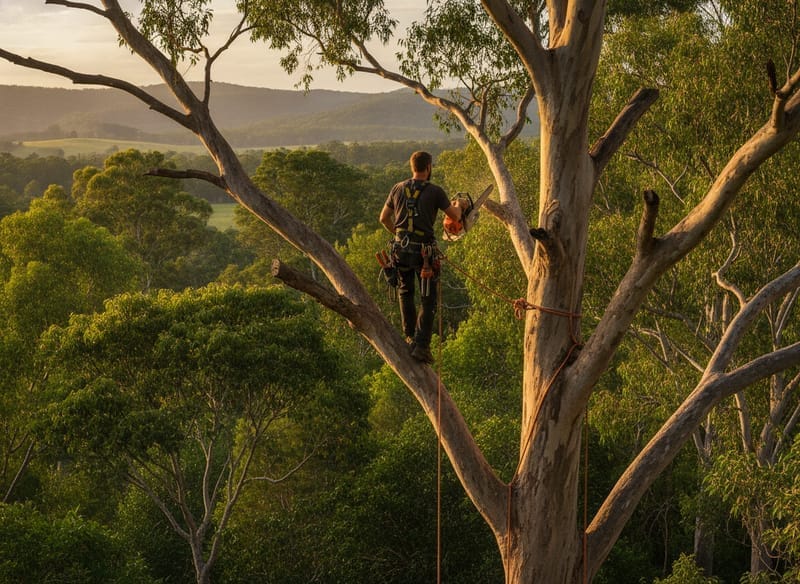
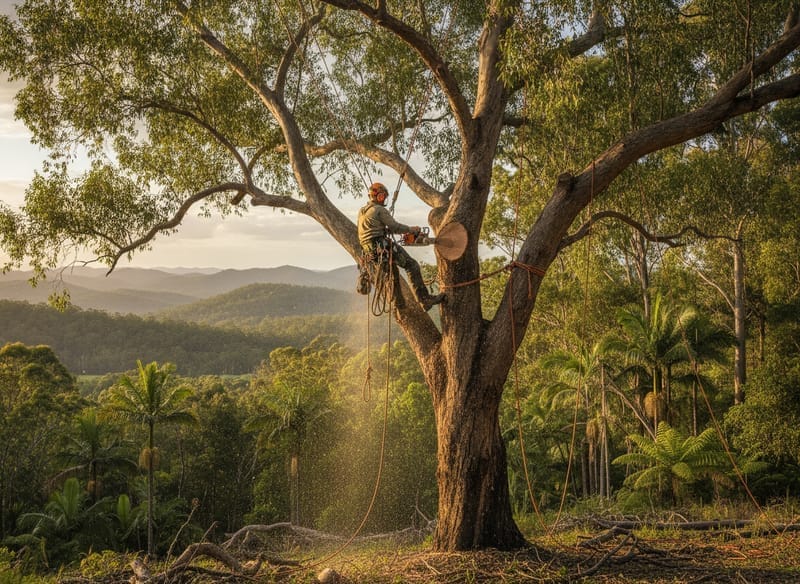
Step 3: Access and Climbing. Mount Stuart is known for its steep gradients, narrow winding streets, and properties with no rear vehicle access. Our climbers frequently use advanced rope-access techniques to safely navigate the canopy, ensuring we don't need heavy machinery that could ruin your terraced garden.
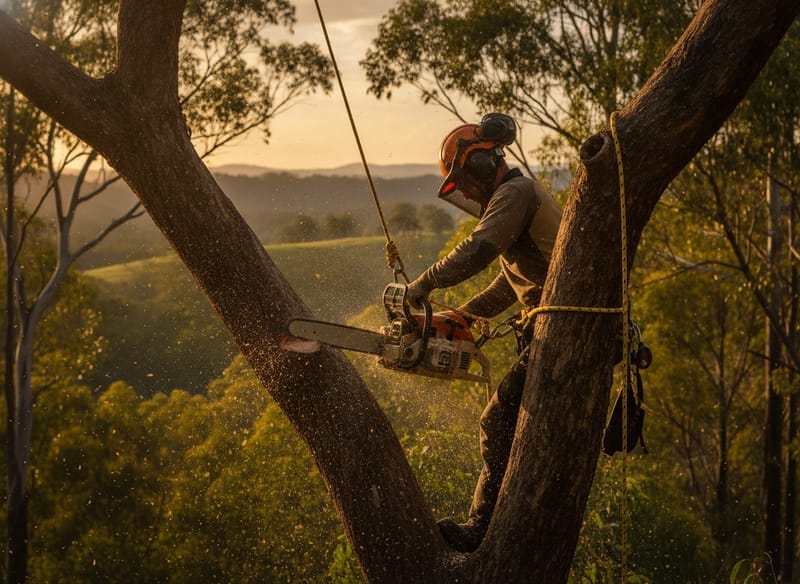
Step 4: Precision Cutting and Rigging. Using top-handle climbing chainsaws and pole pruners, our AQF Level 3 arborists selectively remove limbs. Heavy branches are carefully lowered using ropes and friction devices to protect the structures, garden beds, and sloped ground below.
Step 5: Cleanup and Chipping. All green waste is processed through our wood chippers on the street and carted away in our tipper trucks, leaving your property thoroughly clean and tidy.
Tree work is high risk, especially on the steep eastern foothills of Mount Wellington. Our team operates strictly to the AS4373 (Pruning of Amenity Trees) standard, ensuring all cuts promote natural healing rather than decay. Our climbing team holds AQF Level 3 Certificate III in Arboriculture qualifications, and we are fully public liability insured for your peace of mind.
We also deeply understand the Tasmanian Planning Scheme - Hobart. If your tree sits on the City of Hobart Significant Tree Register or falls under the Local Historic Heritage Code, canopy reduction can trigger council requirements. Our AQF Level 5 consulting arborists can provide the necessary reports to ensure your pruning work remains entirely compliant with local regulations.
Delivering exceptional Tree Lopping Mount Stuart requires deep local knowledge. The suburb features a fascinating mix of 1880s–1920s historic garden plantings—such as massive oaks, elms, and cedars—alongside towering native eucalypts like white peppermint and manna gum.
Because residential blocks climb the foothills of kunanyi, we constantly deal with steep terrain, shallow soils over dolerite, and landslip hazard overlays. Traditional elevating work platforms (cherry pickers) struggle or simply cannot fit on these terraced sites, making our highly skilled rope-access climbers absolutely essential for canopy work here.
We also strictly tailor our canopy reduction to manage the intense westerly and north-westerly frontal systems that sweep down the mountain during winter and spring. Proper crown thinning ensures your retained trees are wind-firm, drastically reducing the risk of a mature limb failing over your expensive roofline.
Once our team has completed the canopy reduction, your tree will need a little time to adjust to its new structure and foliage volume. Because we use proper AS4373-compliant cuts, the tree will compartmentalise and heal naturally—never apply wound paint or sealants, as these trap moisture and encourage rot.
During dry Tasmanian summers, provide deep, infrequent watering around the drip line to help the tree recover. Keep an eye out for any rapid, spindly regrowth, though our precision methods naturally minimise this. We recommend having our arborists return every 3 to 5 years to reassess large mature trees, ensuring they remain safe, healthy, and perfectly proportioned for your property.
Costs depend on whether we are reducing the canopy or completely removing the tree.
We provide free quotes to give you cost certainty.
Providing smarter canopy solutions across the foothills.
Contact us for expert height reduction and canopy management in Mount Stuart.
Call 0400 000 000