Avoid Council Delays
Submit exactly what City of Hobart requires the first time, preventing DA roadblocks.
AQF Level 5 consulting arborist reports for development, hazard assessments, and City of Hobart permit applications.
Consulting services for New Town, Battery Point, Sandy Bay, and greater Hobart.
Our Arborist Report New Town service provides the formal written documentation required by council, insurers, and architects.
New Town has a high concentration of trees on the Significant Tree Register. Any discretionary work on these trees requires a written statement from a suitably qualified person (AQF Level 5). We provide this.
Submit exactly what City of Hobart requires the first time, preventing DA roadblocks.
Back up your tree removal or pruning requests with a certified, legally recognised document.
Ensure your new extension doesn't kill the heritage tree on your block.
We discuss your specific needs (e.g., development, hazard, council permit).
Our AQF5 arborist visits your New Town property to inspect the tree, soil, and site plans.
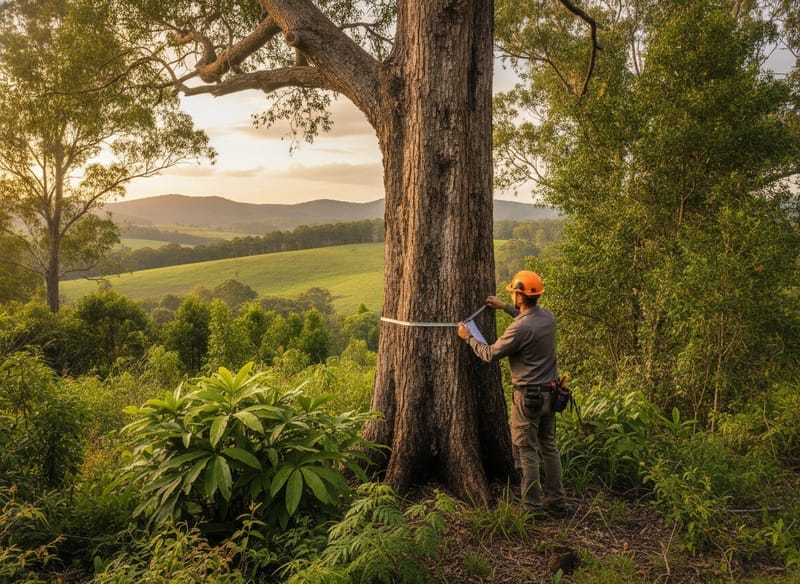
We measure Tree Protection Zones (TPZ), structural root zones (SRZ), and photograph defects.
You receive a comprehensive PDF report ready for council submission.
If you are planning a development, resolving a neighbour dispute, or dealing with a protected tree, you will likely need an Arborist Report New Town to navigate council regulations. At Hobart Arborist, our AQF Level 5 consulting arborists provide the comprehensive, highly detailed assessments required by the City of Hobart. New Town is known for its historic streetscapes, large established exotic canopies of oaks and elms, and native eucalypt stands extending towards the mountain.
Under the Tasmanian Planning Scheme – Hobart, managing these trees often triggers formal assessment, especially if the tree is listed on the Significant Tree Register or falls within a Local Historic Heritage Code precinct. Whether you are subdividing a steep block over shallow dolerite, submitting a Development Application (DA), or managing duty-of-care risks for an aging Tasmanian blue gum overhanging your roof, our team delivers the technical, compliance-ready documentation you need to move your project forward without expensive delays.
A common and costly mistake property owners and developers make is submitting a Development Application or tree removal request without a formally recognised assessment. The City of Hobart does not accept opinions from general landscapers, builders, or even AQF Level 3 climbing arborists when ruling on protected or significant trees. If your documentation lacks an AQF Level 5 consulting arborist sign-off, your application will almost certainly be rejected or stalled with a Request for Further Information (RFI). This wastes weeks of holding costs and frustrates building schedules.
Furthermore, attempting to draft your own tree protection plan for a construction site risks severe penalties if a protected white peppermint or mature English elm is damaged during excavation. Councils require strict adherence to AS4970 (Protection of Trees on Development Sites), which mandates mathematically calculated Tree Protection Zones (TPZ) and Structural Root Zones (SRZ).
Our consulting arborists solve this problem by getting it right the first time. We bridge the gap between your development goals and the council's Local Historic Heritage Code and Natural Assets Code. By identifying constraints early, measuring accurately, and applying the correct Australian Standards, we provide robust, legally sound arborist reports that satisfy council planners and keep your New Town project on track.
Our consulting team provides a full suite of reporting services tailored to the specific environmental and regulatory requirements of the Hobart region.
Comprehensive site assessments required by the City of Hobart for building works near retained trees. We identify species, measure DBH, calculate Safe Useful Life Expectancy (SULE), and outline retention values.
Detailed specifications for protecting trees during construction. We map Tree Protection Zones (TPZ) and Structural Root Zones (SRZ), detailing fencing, root mapping, and supervised work zones for tight New Town building sites.
Formal Visual Tree Assessments (VTA) using industry-standard methodologies. We evaluate defects, structural integrity, and target zones for large aging species like manna gums or historic planes, documenting the likelihood and consequence of failure.
Written assessments for navigating the Local Historic Heritage Code. We document disease, severe structural faults, or unacceptable safety risks to justify the removal of a listed significant tree, including replanting recommendations.
Working alongside geotechnical engineers on the steeper slopes of the Hobart foothills, we provide vegetation management reports that address landslip overlays when significant clearing is required.
Securing an Arborist Report New Town through our team is a streamlined, transparent process designed to integrate smoothly with your project timeline.
All arborist reports produced by our team are authored by an AQF Level 5 Diploma-qualified consulting arborist, ensuring they carry the legal and technical weight required by the City of Hobart and the Tasmanian Civil and Administrative Tribunal (TASCAT). Our assessments strictly adhere to AS4970 (Protection of Trees on Development Sites) and AS4373 (Pruning of Amenity Trees). We operate fully insured with comprehensive public liability, professional indemnity, and WorkCover policies. This dual layer of qualification and insurance protects you, your property, and your project's legal standing when dealing with heritage precincts or significant trees in New Town.
New Town features a unique blend of 19th-century historic gardens and native eucalypt interfaces. This means any given block might host a 120-year-old English oak, a massive Monterey cypress, or a towering Tasmanian blue gum. Under the Tasmanian Planning Scheme – Hobart, tree protection is primarily driven by the Significant Tree Register and the Local Historic Heritage Code. Unlike other states, Hobart does not use a blanket size trigger; a tree is either listed and protected, or it is not.
Our consulting arborists deeply understand these local nuances. If your property falls within a historic landscape precinct or triggers the Landslip Hazard Code on the steeper western slopes towards kunanyi / Mount Wellington, the council will scrutinize your application. We know how to assess the shallow dolerite soils, evaluate prevailing westerly wind impacts on aging canopies, and frame our reports to directly address the specific criteria the City of Hobart demands.
Once you receive your finalised Arborist Report New Town, the immediate next step is submitting it alongside your Development Application or permit request to the City of Hobart. If the report includes a Tree Protection Plan, you must ensure your builders install the specified AS4970 protective fencing and ground protection before any earthworks or machinery enter the site.
If the report recommends remedial pruning, deadwooding, or a justified removal, our AQF Level 3 climbing arborists can execute the physical tree work exactly as specified. Contact us if your site conditions change, if accidental damage occurs during construction, or if you require a project completion sign-off.
The cost of an arborist report depends on its purpose and the number of trees assessed.
Contact us to discuss your project and we will provide a fixed-price quote for the report.
Providing AQF5 consulting across Hobart.
Contact our AQF5 consultants to keep your project moving forward.
Request a Report Quote