Fire Preparedness
Dramatically reduce the radiant heat and ember attack risk to your home.
Safe and compliant vegetation clearing for site preparation and bushfire hazard reduction.
Clearing blocks across Sandy Bay, Mount Nelson and Tolmans Hill.
Our Land Clearing Sandy Bay service prepares blocks for new builds and protects existing homes from bushfire threats.
Suburbs like Sandy Bay, Ridgeway and Tolmans Hill sit directly against dense bushland. The January 2019 fires highlighted the critical need for proactive vegetation clearing and fuel load reduction on these steep interfaces.
Dramatically reduce the radiant heat and ember attack risk to your home.
Provide builders with a clean, accessible site to begin construction.
Selectively clearing overgrown scrub can restore premium Derwent River views from your property.
We walk the block with you to identify boundaries and vegetation to be retained.
We verify constraints under the Landslip Hazard Code and Natural Assets Code.
We remove ground fuels, weeds and small scrub using specialized machinery or hand crews on steep slopes.
Targeted trees are safely felled and processed.
Material is chipped on site to control erosion or removed entirely.
Welcome to Hobart Arborist. If you are preparing a block for a new build, managing bushfire hazards on the bushland interface, or reclaiming overgrown acreage, you need professional Land Clearing Sandy Bay. Sandy Bay is known for its steep, treed blocks climbing the eastern foothills of kunanyi / Mount Wellington, making site preparation a highly technical and demanding job.
Whether it is clearing dense scrub behind an established heritage property or preparing a fresh footprint for residential development, our team has the specialised equipment and local arboricultural expertise to handle the terrain safely. We provide comprehensive land clearing services that respect the local environment while delivering a clean, workable site.
From selective clearing around significant oaks and elms to full understory removal of invasive species and encroaching scrub, our climbers and heavy machinery operators ensure the job is done right the first time. We are committed to leaving your property safe, compliant, and primed for its next phase.
Land clearing in this region is rarely as simple as bringing in a bulldozer. The steep, narrow access roads and shallow dolerite soils of our local terrain make DIY or under-qualified clearing highly dangerous. Amateur operators often indiscriminately push over trees, which drastically damages the structural root zones of the vegetation you actually want to keep, directly violating AS4970 - Protection of Trees on Development Sites.
Poor clearing practices can also trigger severe erosion on our sloping blocks, or land a property owner in hot water with the City of Hobart if significant canopy is destroyed without checking the proper planning overlays. When clearing selectively, heavy-handed lopping of retained trees can introduce structural decay and leave dangerous, unstable canopies right next to your new building footprint.
Our team brings a qualified, precision approach to site preparation. As trained arborists, we assess the vegetation first. We use targeted felling, technical dismantling, and mulching techniques to clear the required footprint while strictly adhering to AS4373 - Pruning of Amenity Trees for any boundary or retained vegetation. This ensures your development site is safe, compliant, and ready for construction without risking the stability of the surrounding landscape.
We utilise specialised machinery and proven arborist techniques to execute land clearing efficiently across the steep and complex sites typical of the Hobart region.
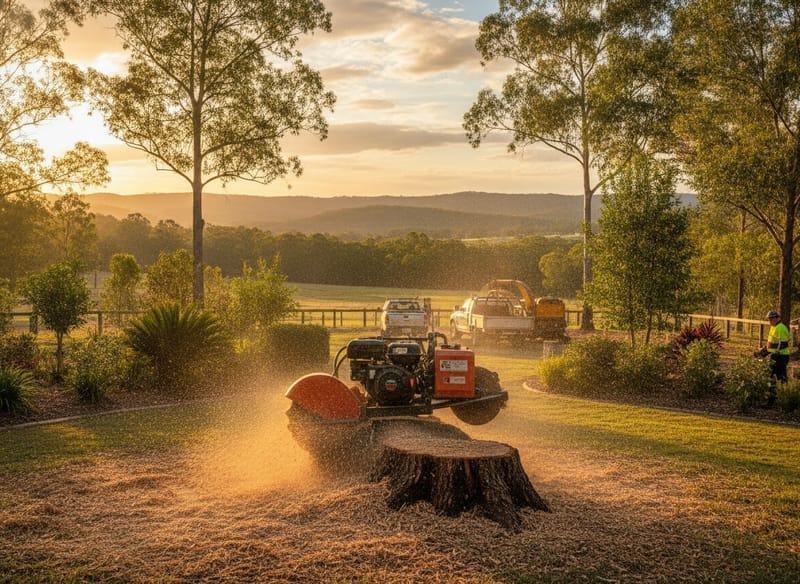
Clearing specific building envelopes and access driveways. We fell, process, and remove vegetation strictly within the approved architectural footprint, leaving a clean, stump-ground grade for your builders to commence work.
Bushfire hazard reduction in interface areas like Mount Nelson and Tolmans Hill. We thin out the understory, remove ladder fuels, and selectively prune canopies to meet AS3959 bushfire attack level (BAL) requirements.
Removing invasive scrub or hazard trees while safely retaining high-value native species like Tasmanian blue gum or established heritage plantings. We establish strict Tree Protection Zones (TPZ) around retained trees.
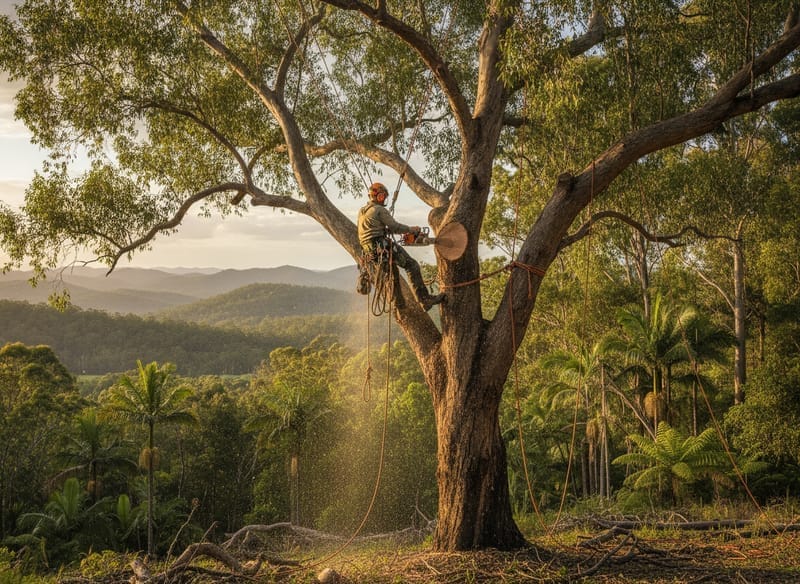
Utilising rope-access dismantling, spider lifts, and crane-assisted removals for blocks where traditional heavy machinery cannot access due to steep slope, landslip hazard, or narrow terraced gardens.
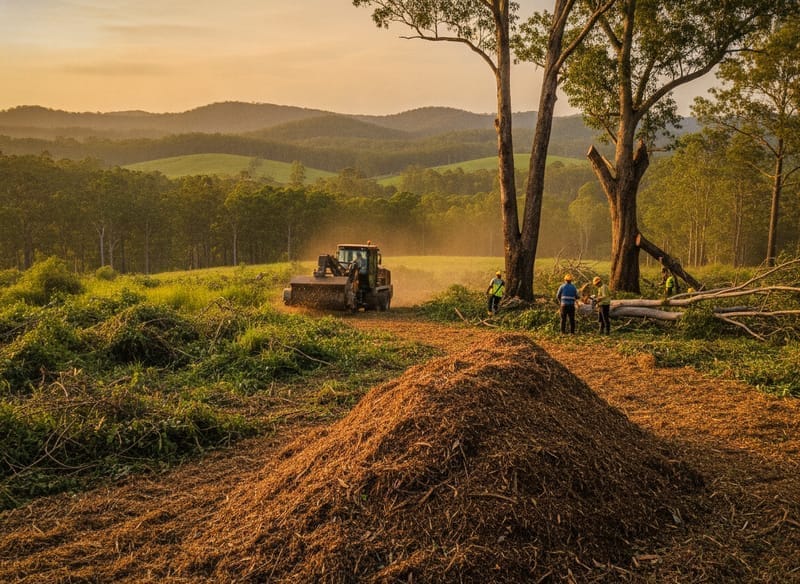
Processing felled timber and scrub through our high-capacity wood chippers. We can leave the mulch evenly spread on-site for immediate erosion control or remove it completely in our tipper trucks.
Delivering professional Land Clearing Sandy Bay requires a meticulous, step-by-step approach to safely navigate our challenging local geography and strict council planning rules.
When undertaking any scale of land clearing, compliance and safety are our highest priorities. Hobart Arborist is fully public liability insured and covered by WorkCover, protecting your property, the public, and our team at all times.
Our crew holds AQF Level 3 certifications for hands-on tree work, and our consulting arborists are AQF Level 5 qualified, allowing us to provide formal arboricultural reports for complex development applications. All retained tree management complies strictly with AS4373 and AS4970. Furthermore, our operators hold current tickets for tree felling, working at heights, EWP operation, and traffic management, ensuring complete safety even on busy, narrow Sandy Bay streets.
Clearing land in this part of Hobart involves navigating unique environmental and regulatory challenges. Our slopes transition quickly from historic 1880s garden plantings—like large English oaks, planes, and cedars—into dry sclerophyll bushland featuring white peppermint, stringybark, and Tasmanian blue gum.
Under the Tasmanian Planning Scheme - Hobart, there is no generic size trigger for tree removal. Instead, protection is heavily based on the City of Hobart Significant Tree Register and the Local Historic Heritage Code. If you are developing a site on the upper slopes, you must also carefully consider the Landslip Hazard Code, where clearing more than 1,000 square metres triggers significant works requirements.
Additionally, bushfire hazard management is a permanent driver for clearing on the western bushland interface. We are highly experienced in navigating these local overlays, providing the necessary AQF Level 5 arborist reports, and executing the clearing work compliantly.
Once your site is cleared, proper post-job management is essential, especially on sloping blocks that experience heavy winter rain. We strongly recommend spreading the chipped mulch evenly across the cleared area to stabilise the shallow dolerite soil, retain moisture, and prevent immediate erosion.
If you are preparing for construction, ensure any protective fencing around retained trees remains intact and unaltered until all heavy building work is entirely complete. Fast-growing invasive weeds can quickly colonise a freshly cleared block in our cool temperate climate, so prompt replanting or building commencement is advised. If you notice epicormic regrowth on retained boundary trees or decide you require stump grinding down the track, simply call our team for follow-up service.
Clearing is priced based on block size, vegetation density and terrain.
We provide a comprehensive, itemised quote for all clearing projects.
Servicing the bushfire interface zones of Hobart.
Contact us today to discuss your site preparation or fire hazard reduction needs.
Get a Free Quote