Immediate Safety
Protect your family and home from imminent structural damage.
24/7 rapid response for dangerous, fallen, and storm-damaged trees.
Immediate dispatch to South Hobart and the foothills.
When you need Emergency Tree Removal South Hobart locals trust us to act fast. High westerly winds sweeping off kunanyi frequently cause root failures and snapped limbs.
Under the Tasmanian Planning Scheme, there are standing exemptions for an unacceptable safety risk or vegetation damaging a building. This means we can act immediately to make your property safe without waiting for a council permit.
Protect your family and home from imminent structural damage.
We handle the dangerous work so you can focus on dealing with insurance.
Call us 24/7. We assess the urgency over the phone.
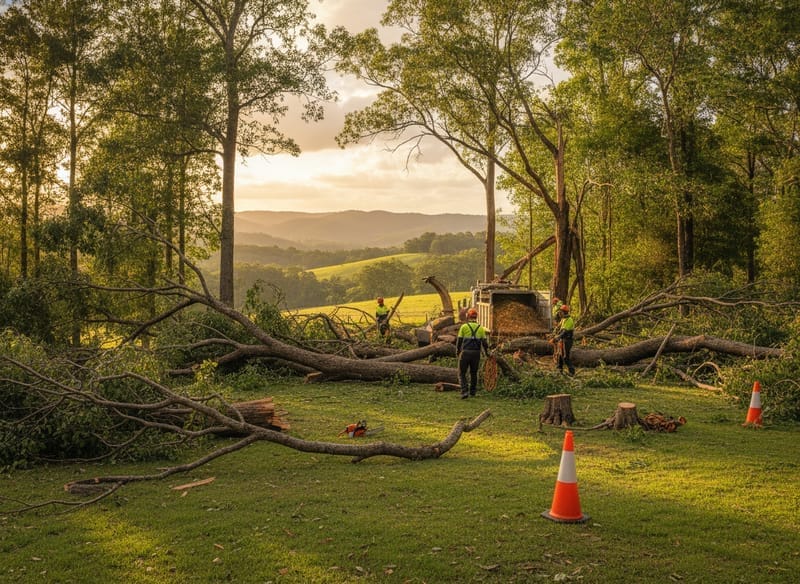
Our crew arrives with chainsaws, rigging gear, and lighting if needed.
We secure the tree, remove the immediate hazard, and tarp roofs if necessary.
We return during daylight to finish wood removal and stump grinding.
When severe westerly winds tear across the eastern foothills of kunanyi / Mount Wellington, large mature trees can fail without warning. If you are facing a fallen, uprooted, or structurally compromised tree, immediate action is critical. Our highly trained team provides the trusted Emergency Tree Removal South Hobart locals can rely on, securing your property from further catastrophic damage.
We understand the unique and challenging terrain of South Hobart. From historic properties with terraced gardens to steep, narrow streets where standard heavy machinery access is often impossible, our local climbing arborists are fully equipped for the challenge. Whether a massive manna gum has uprooted in saturated dolerite soils, or an aging elm has dropped a massive limb onto your roof, we respond swiftly.
We prioritise residential safety above all else. Our crews work diligently to lift heavy timber off structures, clear blocked access ways, and secure hanging branches before they cause secondary damage to your home, fences, or family.
A storm-damaged or uprooted tree is an incredibly complex and highly dangerous hazard. When a massive stringybark or heritage macrocarpa fails, the trunk and remaining limbs are subjected to extreme, unpredictable tension and compression forces.
Attempting a DIY cleanup with a chainsaw is a recipe for disaster. A single incorrect cut can cause the massive trunk to roll, spring back violently, or collapse further onto your house. Furthermore, under-qualified operators or local handymen often lack the critical rigging gear required to lift heavy timber safely off structures. They risk pushing the problem around, inadvertently causing structural damage to your roof that could have been avoided.
Our professional team brings clarity, safety, and strict AS4373 compliance to the chaos of a storm site. We deploy AQF Level 3 qualified climbing arborists who deeply understand the physics of failed trees. We identify load-bearing tension points, use advanced friction rigging to safely dismantle hung-up limbs, and methodically bring dangerous trunks to the ground under total control. By engaging professional arborists, you also ensure that you receive the proper itemised documentation required to streamline your homeowner's insurance claim.
When a tree fails in the steep, access-limited blocks of the Hobart foothills, standard removal methods often fall short. We deploy specialised, high-angle extraction techniques to safely dismantle and remove the timber without causing any further damage to your property.
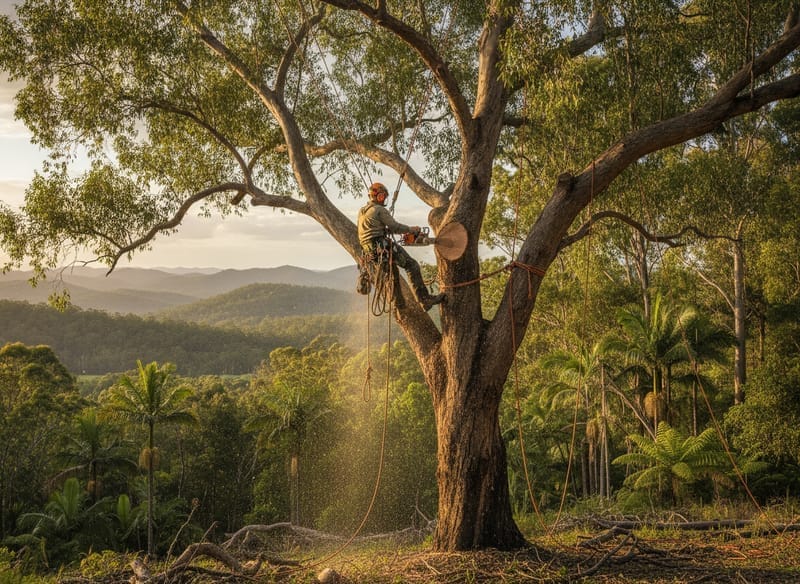
For trees that have fallen directly onto roofs or structures, we use advanced double-rope techniques and specialised friction devices. This allows our climbers to suspend, cut, and lower heavy sections of timber to the ground under complete control, entirely preventing further structural damage.
When large eucalypts or heritage oaks fail on steep South Hobart blocks with absolutely no rear vehicle access, we coordinate emergency crane lifts. This high-level technique allows us to lift multi-ton sections of timber safely over your house directly to the street for immediate processing.
If a tree drops a limb at night or in the middle of extreme weather, our initial response focuses strictly on securing the hazard. We remove the immediate danger, isolate the drop zone, and return during daylight to safely complete the full removal and cleanup process.
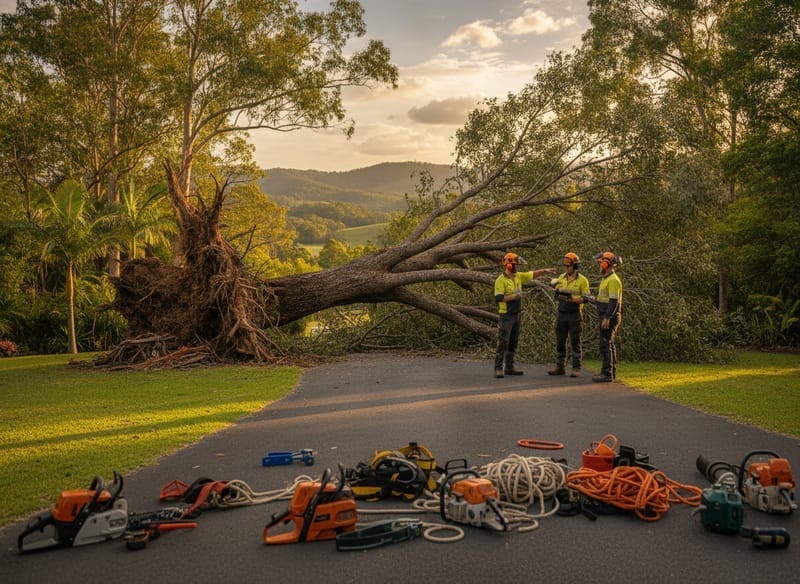
High winds and saturated soils often lead to total root plate failure. Once the canopy and main trunk are safely removed, we carefully process or mechanically stabilise the massive uprooted root ball so it does not flip back into the excavation hole in an uncontrolled manner.
When disaster strikes on your property, a clear and highly efficient process is essential to secure your home and restore your peace of mind. Here is exactly how our team handles urgent tree failures from the first call to the final cleanup.
Emergency tree work is a high-risk operation, which is why all our climbers are AQF Level 3 certified and operate under strict Australian safety frameworks. While AS4373 governs the careful pruning of amenity trees, during an emergency, life and structural safety take absolute precedence.
Our business is fully protected by comprehensive public liability insurance and WorkCover, ensuring your property is covered from the moment our trucks arrive. We strictly adhere to safe work at heights and crane lifting regulations. Furthermore, our AQF Level 5 consulting arborists can provide the necessary photographic evidence and written hazard assessments to satisfy emergency council exemptions.
The City of Hobart manages a very strict tree preservation regime under the Tasmanian Planning Scheme. While there is no general size trigger, many mature oaks, elms, and native Tasmanian blue gums in South Hobart are heavily protected under the Local Historic Heritage Code or sit directly on the City of Hobart Significant Tree Register.
Thankfully, the council provides standing exemptions for trees that pose an unacceptable safety risk. If an ancient cedar or a massive stringybark has split, uprooted, or dropped limbs after a harsh westerly blow, we can legally remove the hazard without waiting weeks for a formal planning permit.
However, the burden of proof remains entirely on the property owner. Our AQF Level 5 arborists provide the required written statement and photographic evidence confirming the tree was imminently dangerous, ensuring you remain fully compliant. We are also well versed in navigating the Landslip Hazard Code when extracting large root systems from the steep, terraced slopes unique to this area.
Once the hazardous tree is completely removed, the immediate danger is gone, but some follow-up property care is necessary. We highly recommend having a licensed builder or roofer inspect any structures that the tree physically impacted, as hidden structural damage or cracked trusses may not be visible from the ground.
On steep South Hobart properties, removing a massive tree can also abruptly alter soil hydrology. Keep a close eye on your retaining walls and terraced garden beds, particularly during heavy rainfall, to ensure the soil remains stable without the tree's deep root system. If you notice surrounding trees looking unbalanced or suddenly exposed to new wind loads, contact us for a proactive canopy assessment.
Emergency work is priced based on the immediate danger and equipment needed (e.g., emergency cranes).
We provide clear, upfront emergency rates before dispatching our crew.
Providing 24/7 emergency response to:
Don't wait. Call our 24/7 emergency response team now.
Call 0400 000 000