Build Ready
Hand over a clean, stump-free site to your builder or earthworker.
Professional block clearing and bushfire hazard reduction for the Hobart foothills.
Specialist clearing for South Hobart, Ridgeway, and Mount Nelson.
For safe, efficient Land Clearing South Hobart residents rely on our machinery and expertise. Whether you're preparing a new build envelope or managing fuel loads, we deliver a clean, workable site.
South Hobart sits directly on the wet sclerophyll interface. The January 2019 fires showed how vulnerable these western suburbs are. Fire hazard reduction under an approved plan or notice is exempt from standard permit requirements, allowing us to actively manage fuel loads to protect your home.
Hand over a clean, stump-free site to your builder or earthworker.
Dramatically reduce the intensity of an approaching fire by removing ladder fuels.
We define the clearing boundaries and identify significant trees to be retained.
We ensure clearing parameters comply with landslip and bushfire overlays.
Using chainsaws and woodchippers, we safely remove the target vegetation.
We grind stumps and spread or remove the resulting mulch.
If you are preparing a block for construction, managing bushfire hazards along the mountain interface, or expanding your useable acreage, our team provides the professional Land Clearing South Hobart residents and developers can rely on.
Hobart’s western shore is uniquely challenging. As properties climb the steep eastern foothills of kunanyi / Mount Wellington, the terrain transitions from dense, historic urban gardens into wet sclerophyll bushland. This environment requires a highly specialized approach to vegetation management. The combination of shallow soils over dolerite, narrow winding streets, and exposure to intense winter westerly wind events means that clearing land here is never a simple job of just rolling in heavy machinery.
Our qualified arborists understand the specific demands of the Hobart climate and local council regulations. Whether you are clearing a footprint for a new architectural build on a steep slope, establishing an Asset Protection Zone (APZ) for bushfire safety, or selectively thinning a block while retaining significant eucalypts, we deliver safe, efficient, and fully compliant clearing services.
Attempting DIY site preparation or hiring under-qualified operators for land clearing in our region frequently leads to costly property damage, council fines, and unsafe site conditions. South Hobart features challenging topography, with many residential blocks perched on steep inclines lacking traditional rear vehicle access. Inexperienced operators often try to force heavy earthmoving machinery into these sensitive areas, which can severely compact the soil and irreversibly damage the Structural Root Zones (SRZ) of the mature trees you intend to keep.
Furthermore, uncontrolled felling of large, localized species like Tasmanian blue gum (Eucalyptus globulus) or white peppermint (Eucalyptus pulchella) poses a massive risk to nearby homes, retaining walls, and utility lines. If a contractor ignores the City of Hobart's Landslip Hazard Code or illegally removes a tree protected under the Local Historic Heritage Code, the property owner is left bearing the legal responsibility and financial penalties.
Our team provides the professional solution. We bring AQF Level 3 climbing arborists and AQF Level 5 consulting expertise to every project. Instead of indiscriminate bulldozing, we utilize advanced rigging, rope-access techniques, and controlled dismantling to clear vegetation safely. We protect your retained trees to AS4970 standards, manage the steep dolerite terrain carefully, and ensure every phase of the project meets strict local compliance.
We utilize a combination of heavy-duty processing equipment and highly technical arboriculture methods to manage vegetation across Hobart’s demanding topography.
We clear construction footprints for new homes, extensions, and sheds. This involves the systematic dismantling of hazard trees and scrub, alongside the installation of Tree Protection Zones (TPZ) to ensure retained canopy is kept safe from builders' machinery.
Living against the wet sclerophyll bush requires strict bushfire hazard management. We selectively thin understory vegetation and reduce canopy fuel loads to create compliant Asset Protection Zones under AS3959 standards, safeguarding your property.
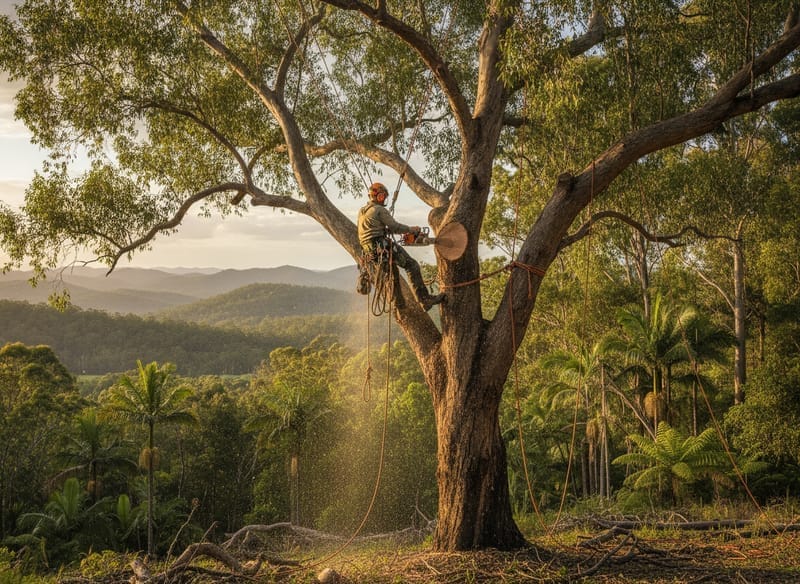
For hillside blocks with no vehicle access, we utilize rope-access climbing, rigging, and spider lifts. We dismantle large timber piece-by-piece and use crane-assisted removals to extract heavy logs over homes without damaging terraced gardens.
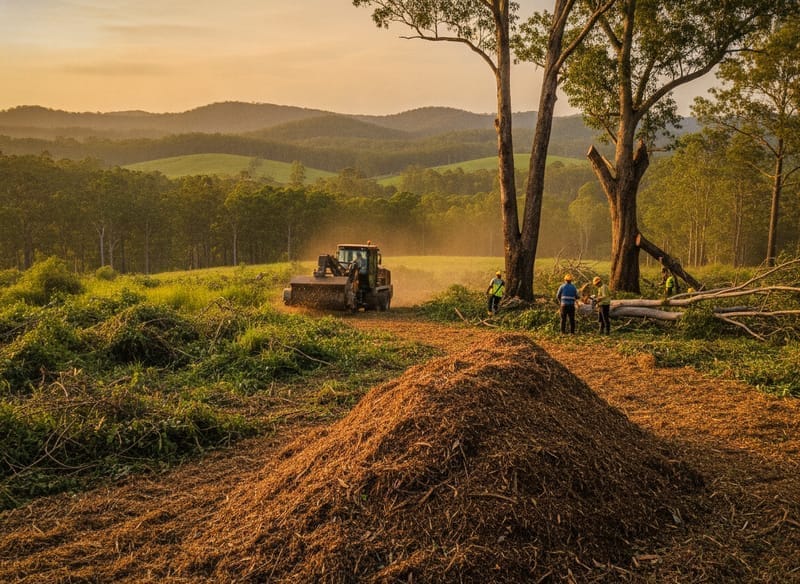
We deploy high-capacity 12-inch wood chippers to process cleared branches and scrub on-site. The resulting mulch can be removed in our tipper trucks or left on your block to suppress weeds and provide essential erosion control on sloped land.
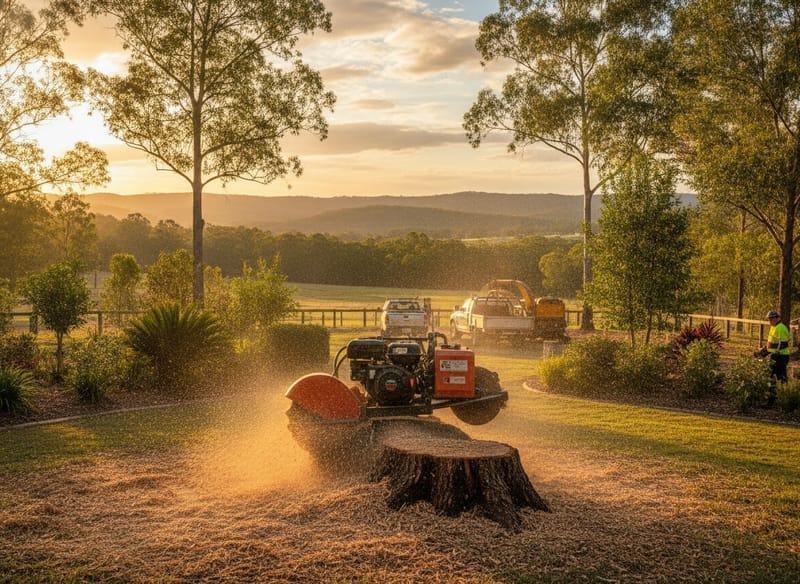
To prepare your site for earthworks, we grind tree stumps down to 150–300mm below grade. We carefully chase surface roots, ensuring a smooth, clear block ready for your builders or landscape architects.
Step 1: Comprehensive Site Assessment. We begin with an on-site consultation at your property. Our arborists assess the vegetation, soil stability, and access constraints. We cross-reference the site against the Tasmanian Planning Scheme, checking for Local Historic Heritage Code listings and Landslip Hazard Code overlays to determine exact permit requirements.
Step 2: Quotation and Methodology Planning. We provide a transparent, detailed quote outlining our specific approach. Whether the job requires heavy loader cranes for a large manna gum removal, or manual rope-access dismantling in a tight gully, our methodology is clearly explained upfront.
Step 3: Site Protection and Set Up. Before any cutting begins, we mark all vegetation scheduled for retention. We establish physical barriers and Tree Protection Zones (TPZ) in accordance with AS4970 to protect the structural root systems of heritage oaks, elms, or native eucalypts from heavy foot traffic and machinery.
Step 4: Systematic Clearing. Our qualified arborists execute the clearing plan using top-handle saws (like the MS201T) for elevated work and high-powered ground saws for felling. Timber is processed systematically, with limbs fed into our high-capacity chippers to manage the waste footprint immediately.
Step 5: Final Clean-Up and Handover. We grind the remaining stumps, rake the site, and either haul the green waste away in our tipper trucks or stockpile the mulch for your future landscaping use. We leave your block completely tidy and ready for the next phase of development.
Professional land clearing demands strict adherence to Australian Standards and workplace safety laws. Our business is fully covered by comprehensive public liability insurance and full WorkCover for all employees, protecting you from any financial risk during high-hazard tree work.
We strictly follow AS4970 - Protection of Trees on Development Sites, ensuring that the heavy machinery and earthworks associated with clearing do not compact the root zones of the trees you choose to retain. Our operations also align with AS4373 - Pruning of Amenity Trees when selectively clearing and lifting canopies. With AQF Level 3 climbing arborists on site and AQF Level 5 consultants available for complex council reporting, our safety and compliance frameworks are entirely airtight.
Executing Land Clearing South Hobart jobs requires a deep understanding of local ecology and municipal planning. This area transitions from dense 1880s heritage garden plantings—featuring enormous oaks, elms, and cedars—into dry and wet sclerophyll eucalypt forests. Unlike some regions, the City of Hobart does not have a blanket size trigger for tree removal. Instead, protection is based heavily on specific schedules.
The Local Historic Heritage Code strictly protects trees listed on the Significant Tree Register. Removing a listed tree for land clearing requires formal council approval, usually supported by an AQF Level 5 arborist report. Furthermore, because of the steep terrain climbing towards Mount Wellington, the Landslip Hazard Code frequently comes into play; clearing more than 1,000 square metres is classified as significant works and requires specialized soil stabilization strategies.
We are highly experienced in navigating these specific Tasmanian Planning Scheme overlays. From managing the removal of towering stringybarks (Eucalyptus obliqua) that threaten homes during winter north-westerly fronts, to clearing understory safely on dolerite rock, we tailor our approach to suit the unique Hobart environment.
Once the land clearing is complete, managing the newly exposed soil is crucial to the long-term health of your property. We highly recommend spreading the processed mulch across bare ground; this suppresses environmental weeds and provides vital erosion control, which is especially critical on Hobart’s steep, rain-prone slopes.
You should also closely monitor any retained trees. Trees that were previously buffered by surrounding scrub may now face increased exposure to our strong westerly winds. If you notice signs of stress, weak epicormic growth, or deadwood developing in your remaining white peppermints or blue gums, contact our team. We can schedule an AS4373-compliant follow-up prune to reduce wind resistance and ensure the canopy remains safe and structurally sound.
Land clearing costs scale with the density of the vegetation and the topography of the site.
We'll meet you on-site to understand your exact goals and provide a fixed-price clearing quote.
We clear blocks and manage bushfire hazards in:
Contact us today for professional land clearing in South Hobart.
Get a Clearing Quote