Streamline Your DA
Avoid council knockbacks by submitting comprehensive, compliant tree reports the first time.
Independent, AQF Level 5 consulting arborist reports for development applications and council compliance.
Consulting across West Hobart, Battery Point, Sandy Bay, and the Hobart region.
An Arborist Report West Hobart provides the formal documentation required by councils, insurers, and developers to make informed decisions about vegetation.
West Hobart features dense residential housing under significant heritage canopy. Managing the intersection of new extensions, retaining walls, and existing tree root zones requires careful, documented planning to satisfy the Local Historic Heritage Code.
Avoid council knockbacks by submitting comprehensive, compliant tree reports the first time.
Base your tree management decisions on independent, legally recognised expert advice.
Learn exactly how to build near significant trees without destroying their critical root zones.
We discuss your project goals, whether it's a DA submission or a risk concern at your West Hobart property.
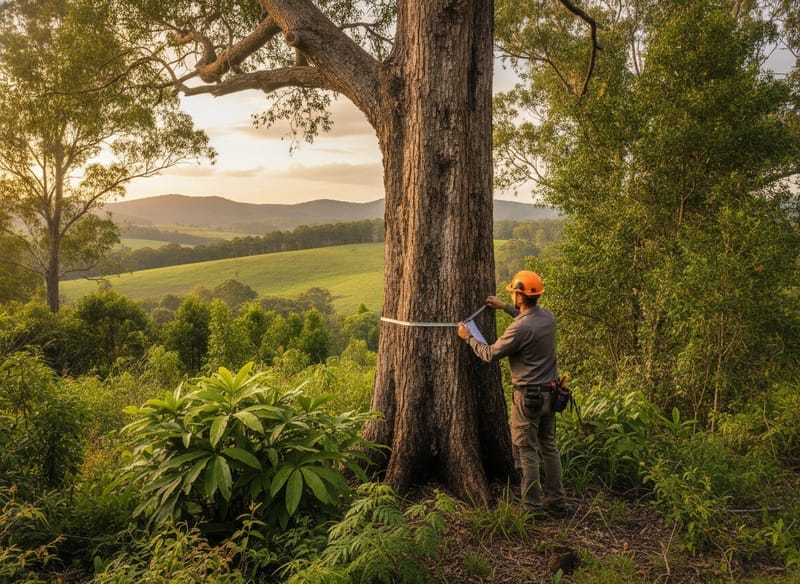
Our AQF Level 5 arborist visits the site to collect data, measure DBH, calculate TPZs, and assess tree vitality.
We evaluate the data against the Tasmanian Planning Scheme and relevant Australian Standards.
You receive a comprehensive, high-quality written report ready for submission to the City of Hobart.
If you are planning a property development, managing historic heritage trees, or dealing with a potentially dangerous Tasmanian blue gum on a steep residential block, you need a professional Arborist Report West Hobart. Our team of AQF Level 5 consulting arborists provides comprehensive, council-compliant reports for homeowners, developers, and property managers across West Hobart, Mount Stuart, and Battery Point.
Because our eastern foothills sit on dolerite soils with steep gradients and frequent westerly wind exposure, tree management here requires specific local expertise. Whether you are navigating the City of Hobart's Local Historic Heritage Code for a 1920s garden oak or submitting a Development Application that impacts native canopy, we deliver the exact documentation you need to move forward.
We do not just assess trees; we provide clear, actionable advice to keep your project legally compliant and safe. From pre-purchase inspections to detailed structural risk assessments of aging elms and plane trees, our reports ensure you meet all planning scheme requirements without unnecessary delays.
Navigating the Tasmanian Planning Scheme can be a frustrating process, especially when dealing with the City of Hobart's Significant Tree Register. Submitting a Development Application or a tree removal request with a generic, under-qualified tree assessment is the fastest way to get your project delayed or outright rejected. Council planners will simply not accept assessments from unqualified operators or DIY evaluations.
A poorly documented report often fails to accurately calculate Tree Protection Zones (TPZ) or Structural Root Zones (SRZ) as mandated by AS4970 Protection of Trees on Development Sites. This oversight can lead to compliance breaches, unexpected stop-work orders, or severe damage to retained trees during your build. On the steep, landslip-prone blocks of West Hobart, ignoring the broader environmental impacts of tree removal can also trigger costly requests for further information from the council.
We solve this by providing authoritative, AQF Level 5 consulting arborist reports. Our assessments are rigorously structured, scientifically backed, and tailored to satisfy council planners the first time. We conduct thorough Visual Tree Assessments (VTA) and ensure all retention or pruning recommendations align strictly with AS4373 Pruning of Amenity Trees, protecting your property, your safety, and your project timeline.
Our AQF Level 5 arborists utilise industry-standard methodologies and advanced diagnostic tools to deliver precise, compliant, and highly detailed reports for your specific site requirements.
We produce detailed tree inventories for sites undergoing construction or subdivision. This includes species identification, Diameter at Breast Height (DBH) measurements, Safe Useful Life Expectancy (SULE) ratings, and clear retention recommendations to satisfy City of Hobart planning requirements.
Essential for building works near retained trees. We calculate and map out Tree Protection Zones (TPZ) and Structural Root Zones (SRZ), specifying protective fencing, root mapping procedures, and mulch requirements to protect tree health throughout the construction phase.
We evaluate the structural integrity of mature trees using industry-recognised VTA methodologies. We systematically document structural defects, evaluate target zones such as roofs and footpaths, and calculate the likelihood of failure during Hobart's intense winter wind events.
When a tree poses an unacceptable safety risk or is in terminal decline, we compile the necessary evidentiary report. We document the hazard and outline why pruning or retention is unviable, ensuring compliance with the Local Historic Heritage Code if the tree is on the significant register.
We provide comprehensive site audits for property buyers, strata managers, and schools. We identify hazardous branches, compromised root systems, or dying wood before they cause costly damage, providing peace of mind and demonstrating your legal duty of care.
Securing a comprehensive Arborist Report West Hobart from our team is a streamlined, transparent process designed to keep your development or safety project on track.
Every consulting report we produce is written and signed off by an AQF Level 5 Diploma-qualified arborist, which is the standard credential required by the City of Hobart for discretionary planning applications. Our site assessments strictly adhere to AS4970 for development protection and AS4373 for any prescribed canopy pruning works.
Liability protection is at the core of our consulting business. Our team is fully backed by comprehensive Professional Indemnity and Public Liability insurance, ensuring you are completely protected when relying on our expert advice. From residential backyard assessments to large strata management plans, our approach guarantees total compliance with state safety and environmental regulations.
Commissioning an Arborist Report West Hobart requires an intimate understanding of the local landscape and regulatory environment. The eastern foothills of kunanyi are characterised by steep dolerite slopes, shallow soil profiles, and narrow, winding streets where structural tree failure can have devastating consequences.
The residential canopy here is a complex mix of endemic dry sclerophyll eucalypts, like white peppermint and Tasmanian blue gum, alongside magnificent 1920s heritage garden plantings of massive European oaks, elms, and cedars. Many of these exotic trees have outgrown their safe service life and sit high above expensive heritage homes.
The City of Hobart protects these significant trees by listing them directly on a register, rather than using a blanket trunk-size trigger. Removing or heavily modifying a listed mature tree in a historic landscape precinct requires a highly detailed, AQF Level 5 backed justification. We understand these local nuances, alongside the winter north-westerly frontal systems that frequently drive the need for our urgent structural risk assessments.
Once we hand over your completed arborist report, the immediate next step is to submit the PDF alongside your Development Application or council permit request. Always keep a digital copy on hand for your builder, architect, or site manager, as they will need to implement the documented Tree Protection Zones (TPZ) before any heavy machinery arrives on site.
If your report outlines a required schedule for formative pruning, canopy reduction, or deadwooding to mitigate risks, contact our team to book our AQF Level 3 climbing arborists for the physical tree work. For large retained trees, we highly recommend scheduling an updated visual risk assessment every two to three years.
Consulting arborist reports are priced based on the complexity and purpose of the assessment.
We provide a fixed-fee proposal before commencing any consulting work.
We provide consulting arborist services to all Hobart municipalities.
Contact us today to discuss your council, development, or tree risk assessment needs.
Request a Quote